M&A Bytes: Share Sale vs Asset Sale

Are you buying the company or just what’s inside it? One decision. Major Consequences.

Every business acquisition starts with a critical question: Are you buying the company, or just the assets that matter to you?

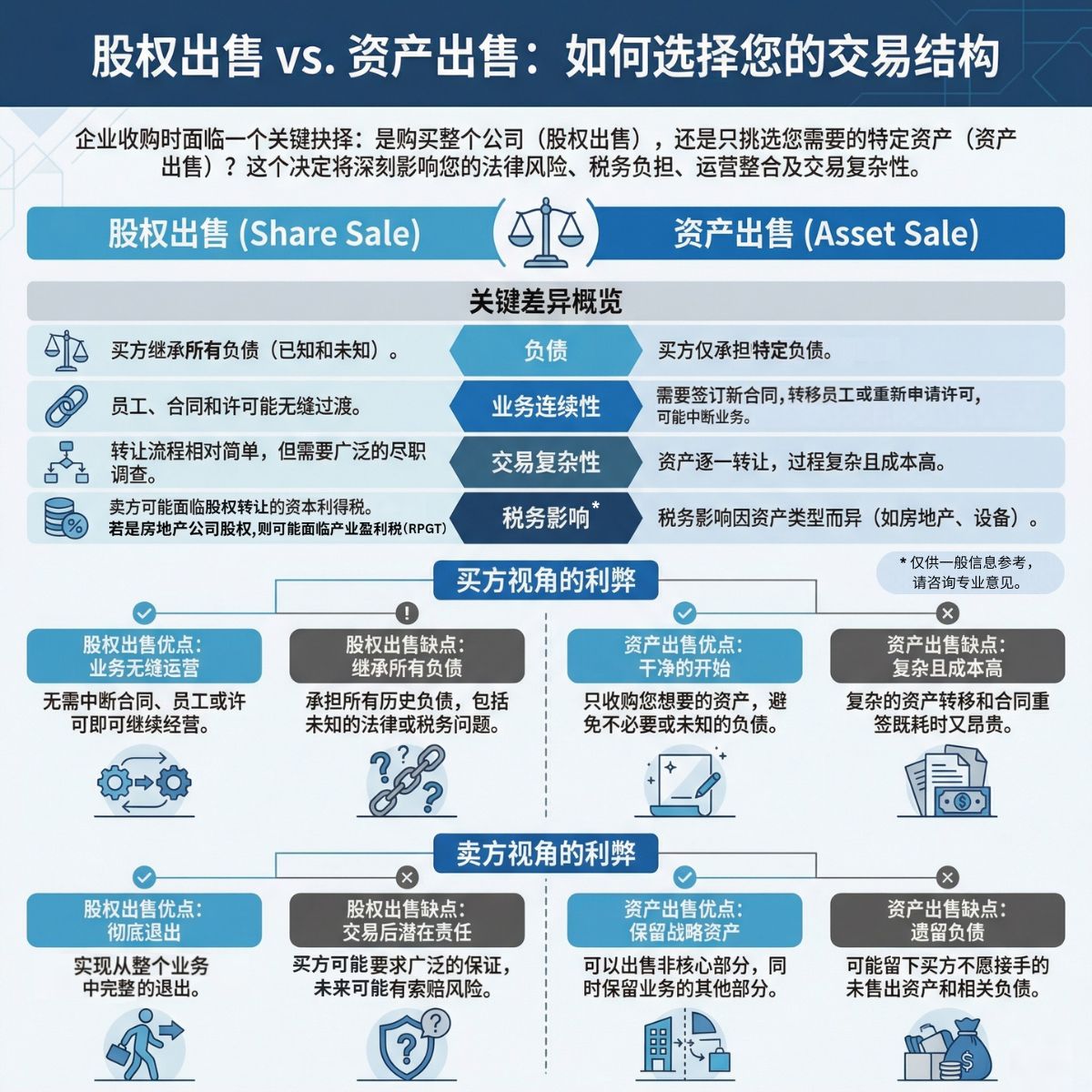
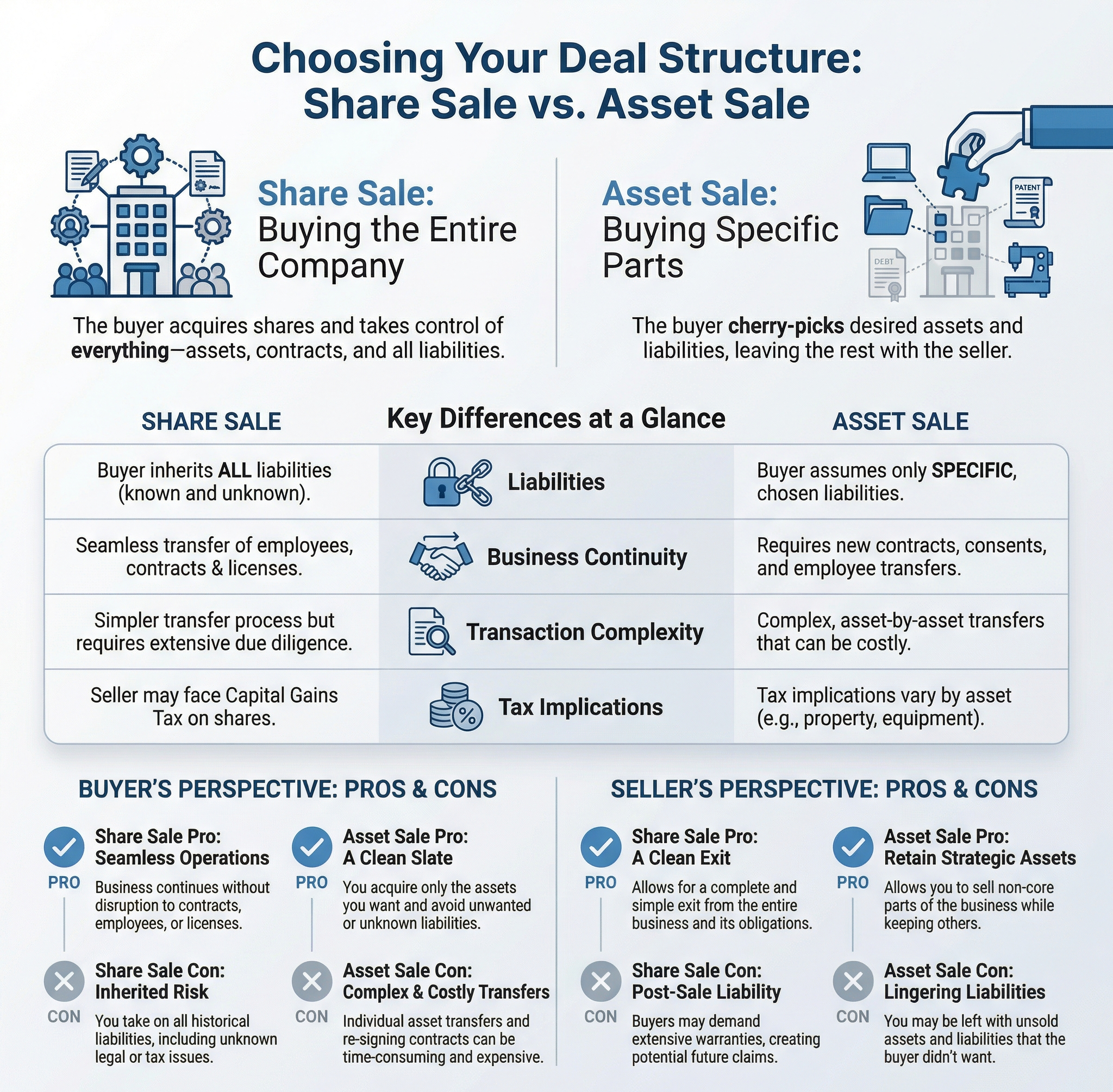
  • In a Share Sale, you acquire shares in the company — this may be 100% of the shares (full control) or a partial share sale. In either case, you take on the company’s assets, liabilities, contracts and its full corporate history.
  • In an Asset Sale, you selectively acquire only the assets and operations you want, leaving the rest with the Seller.

Key Differences between Share Sale & Asset Sale:

Aspect Share Sale Asset Sale
What’s Being Sold/ Scope Buyer acquires ownership of shares and gains control of the entire company, including all assets and liabilities. Buyer acquires specific assets and liabilities (e.g. properties, equipment and machinery, etc.). Seller retains the rest.
Contract Parties The shareholder and the Buyer. The company itself and the Buyer
Tax Implications

(For general information only. Please seek professional advice for actual tax implications.)

  • May be subject to Capital Gains Tax on gains from the disposal of unlisted shares (if the Seller is a company, limited liability partnership, trust body or co-operative society).
  • May trigger Real Property Gains Tax (“RPGT”) (if it’s shares in a real property company).
  • Stamp duty may apply on share transfers.
  • No stamp duty on individual assets (because no change in asset ownership).
  • Ad valorem stamp duty may apply per transfer of asset (land, property, etc.)
  • Gains from disposal may be taxable depending on the type of asset:
    • Real property → RPGT
    • Plant & Machinery / Equipment → Balancing charges (A balancing charge is added when an asset is sold above its tax written-down value.)
Consents & Approvals
  • Pre-emption rights or tag-along rights may apply
  • Change-of-control clauses in contracts may require consent.
  • May require third-party consents, novations, assignments and approvals.
  • Board/shareholder resolutions may be required if a “substantial portion” of the business is disposed of (Section 223 Companies Act 2016).
Employment No change of employer, employee consent is not required.
  • No automatic transfer of employees. Employee’s consent will be required.
  • Employment procedures, notice periods and termination benefits under the Employment Act 1955 and Employment (Termination and Lay-Off Benefits) Regulations 1980 may be applicable (mainly for employees earning ≤ RM4,000 or manual labour).

* Note: Employees who reject equally favourable terms may lose entitlement to termination benefits.

Due Diligence Considerations
  • Review corporate records and governance compliance.
  • Check litigation, regulatory compliance, and tax filings.
  • Investigate related-party transactions and contingent liabilities.
  • Verify title and ownership of assets.
  • Assess encumbrances or security interests.
  • Review assignability of contracts and licences.
  • Perform physical inspection of assets.
Warranties & Indemnities
  • Warranties generally cover all aspects of the target company.
  • Indemnities typically for tax, litigation and contingent liabilities.
  • Warranties limited to specific assets sold.
  • Indemnities are narrower, depending on the asset type and exposure.

Pros & Cons for Buyer and Seller:

Share Sale

Party Pros Cons
Buyer
  • Continuity of business and operations.
  • No need to reassign contracts or employees.
  • Maintains existing licenses and permits.
  • Preserves goodwill and the company’s brand reputation.
  • Inherits all existing liabilities (both known and unknown).
  • Potential exposure to historical or ongoing litigation or statutory breaches of the company.
  • Extensive due diligence is required to uncover potential risks.
Seller
  • Potentially higher sale price, as the buyer acquires the whole company.
  • Clean exit from the business.
  • Fewer transfer formalities (i.e. no individual transfer of assets).
  • Buyers may demand extensive warranties or indemnities to mitigate risk.
  • Potential liability from post-completion claims if warranties/indemnities are triggered.
  • Negotiations may be complex due to liability concerns.

Asset Sale

Party Pros Cons
Buyer
  • Can selectively acquire assets and liabilities.
  • May avoid unwanted or unknown assets or liabilities.
  • Lower risk of inheriting historical or existing litigation or regulatory non-compliance.
  • Asset-by-asset transfers can be time-consuming.
  • Higher legal, registration, stamp duty and potential tax costs
Seller
  • Can sell specific assets while retaining core or strategic parts of the business.
  • Allows monetisation of certain assets for reinvestment or restructuring.
  • Warranties, indemnities and terms can be tailored for each asset.
  • The sale price may be lower due to a selective asset purchase.
  • Asset-by-asset transfers can be time-consuming.
  • Employees don’t automatically transfer — possible claims.
  • May retain certain liabilities not assumed by the buyer.
  • Tax implications vary by asset.

🔑 Key Takeaway: 

Choosing between Share Sale and Asset Sale is more than just a technical decision – it affects your legal exposure, tax implications, operational control and transaction complexity.

In Essence:
Disclaimer: The content of this article is intended for general informational purposes only and does not constitute formal legal advice.

Our Corporate team regularly advises local and international corporations on mergers and acquisitions (M&A), cross-border transactions, joint ventures, and corporate restructuring. We also provide comprehensive support for shareholders’ agreements and general commercial advisory to help businesses navigate the Malaysian regulatory landscape.

For legal assistance or further inquiries regarding your corporate matters, please feel free to contact us.