M&A Bytes: Common Documents in an M&A Deal

M&A Bytes: Common Documents in an M&A Deal

Behind every M&A transaction lies a stack of documents, each with a purpose.

Whether you are the vendor, buyer, solicitor or part of the target company’s management, understanding the role of each document is crucial.

This M&A Byte maps out:

  • The core documents in a typical deal
  • When they appear in the transaction lifecycle
  • Why each one matter

Phase 1: Setting the Foundation 

Document Function
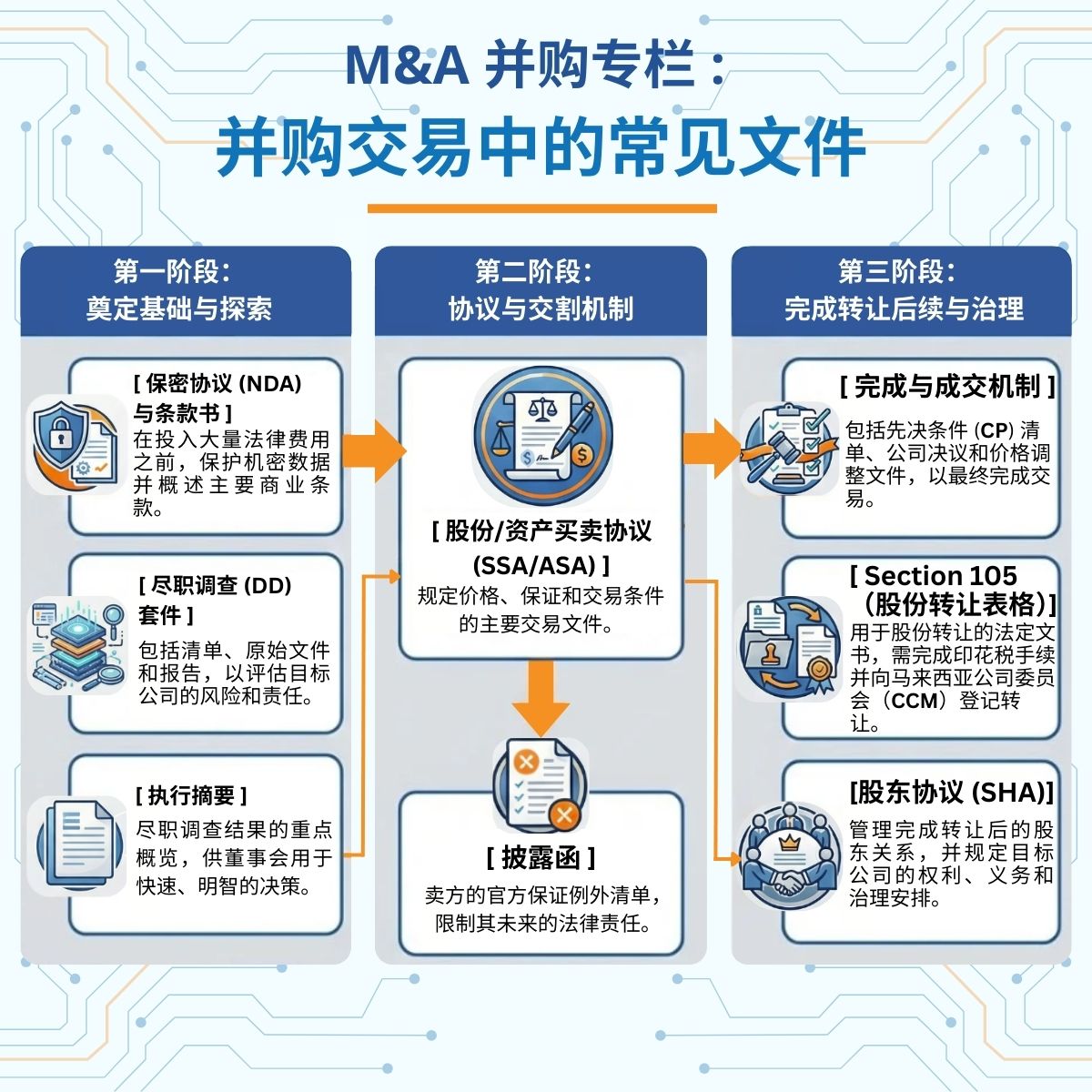
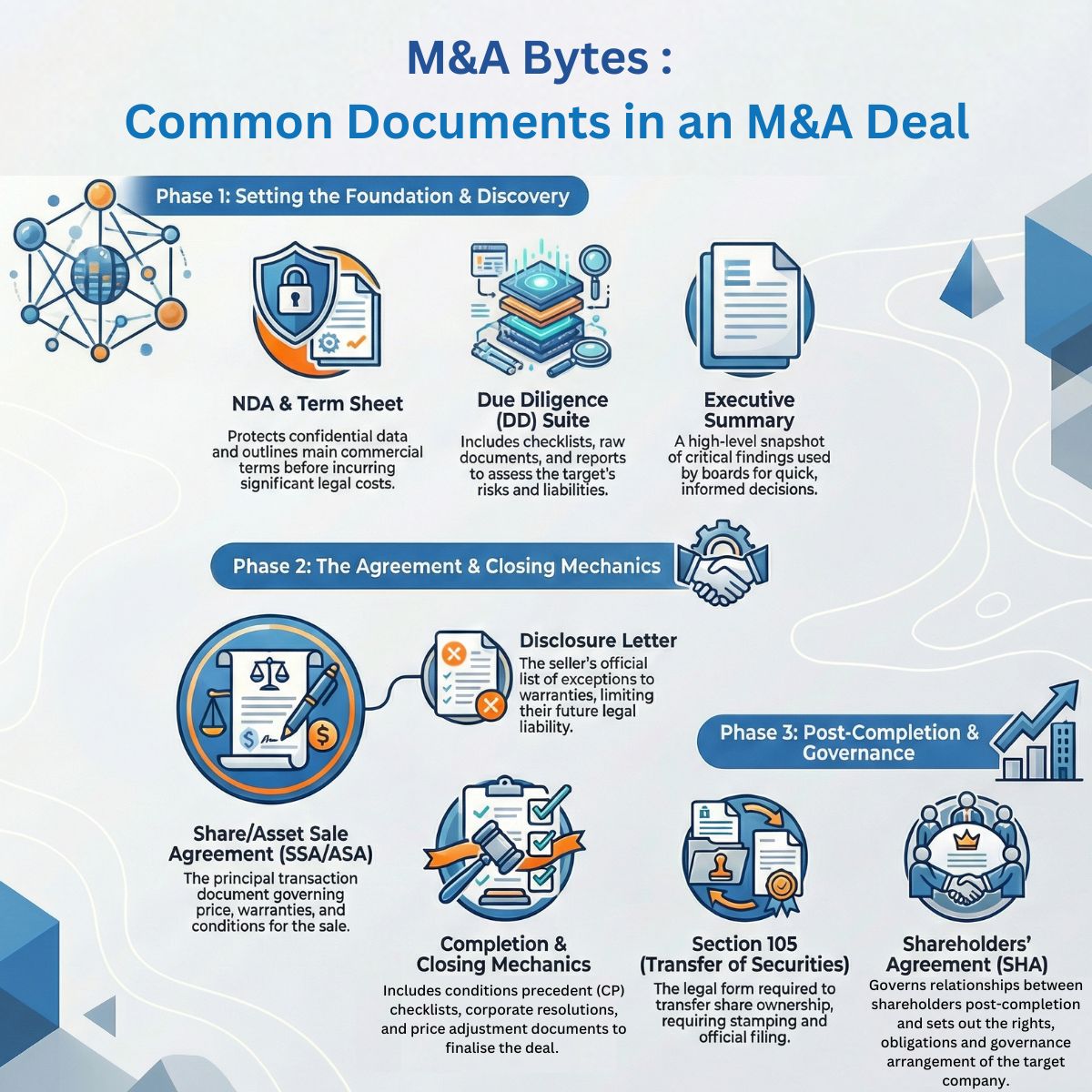
Non-Disclosure Agreement (NDA)
  • Signed before confidential information is shared for due diligence, typically after preliminary discussions or upon signing a Term Sheet.
  • Prevents the Buyer (and its advisors/solicitors) from using the information for purposes other than the transaction.
  • Protects confidential and high-level information shared by the Seller
  • Can be mutual if both parties disclose sensitive information
Term Sheet / Letter of Intent (LOI)
  • Sets out the main commercial terms (e.g. price, structure, timeline, exclusivity).
  • Provides a framework for negotiation and drafting of the Share Sale Agreement (“SSA”) or Asset Sale Agreement (“ASA”).
  • While usually non-binding, certain clauses (e.g. exclusivity, confidentiality, break-up fees, etc.) can be binding.
  • Helps both parties confirm alignment on key points before incurring further costs.
Due Diligence Checklist / Questionnaire 
  • Prepared by the Buyer’s solicitors to request key documents and information about the target company from the S
  • Forms the foundation for the due diligence process.
Due Diligence Documents 
  • Reviewed by Buyer’s solicitors to: –
    • inspect the target company’s background and
    • assess potential risks or liabilities.
  • E.g.:
    • Corporate records (company secretarial forms)
    • Material and operational contracts
    • Employment documents
    • Regulatory and litigation records
    • Financial statements
    • Tax filings

Phase 2: The Discovery & Core Agreements

Document Function
List of Outstanding Issues/ Documents
  • After the initial Due Diligence Documents are provided for review, some items may be incomplete or require clarification.
  • These tracks follow-up questions and requests for missing or incomplete documents.
  • It maintains a clear record of what was requested, received and still pending.
Due Diligence Report
  • A report detailing the Buyer’s review of the Seller’s business.
  • Includes findings on corporate, legal, operational and regulatory matters of the target company.
  • Identifies risks, liabilities and potential deal issues.
  • Highlights gaps, inconsistencies, or red flags in documentation.
  • Provides the foundation for negotiation and adjustments to the terms in SSA/ASA.
Executive Summary 
  • Condensed and high-level version of the Due Diligence Report.
  • Highlights the critical findings and key risks.
  • Used by senior management or boards to make informed decisions quickly.
Share Sale Agreement (“SSA”) /

Asset Sale Agreement (“ASA”)

  • The main transaction document, which sets out the detailed terms of the sale.
  • Covers purchase price, representations and warranties, conditions precedent and completion deliverables.

Phase 3: Completion & Closing Mechanics

Document Function
Conditions Precedent (“CP”) /

Completion Checklists

  • For both Seller and Buyer to track fulfilment of CP / Completion Deliverables.
Disclosure Letter
  • Prepared by the seller to disclose exceptions to the warranties given in the SSA/ASA.
  • Helps limit the seller’s post-completion liability.
Resolutions
  • Formal approvals by directors and shareholders to authorise the deal and any other matters contemplated for the transaction.
  • Without proper resolutions, the transaction may be rendered invalid or unenforceable.
Completion Accounts /

Purchase Price Adjustment Documents

  • Prepared to calculate adjustments to the final purchase price based on the actual financial position of the company at completion.

Phase 4: Post- Completion 

Document Function
Section 105 (Form of Transfer of Securities)
  • The legal transfer of share ownership from the Seller to the Buyer.
  • Executed by both the Seller (as a transferor) and the Buyer (as a transferee).
  • For the enforceability, the form needs to be:-
    • stamped and filed with the Companies Commission of Malaysia, and
    • reflected in the company’s Register of Members.
Shareholders’ Agreement (SHA)
  • Governs relationships between the company shareholders after completion.
  • Sets out rights, obligations and governance arrangements of the target company.

🔑 Key Takeaway: 

Every M&A deal is built on a suite of documents, each shaping the deal, defining risks and guiding decisions.

Understanding the purpose and interplay of these documents is essential for smooth execution, effective risk management and informed decision-making.

In Essence:
Disclaimer: The content of this article is intended for general informational purposes only and does not constitute formal legal advice.

Our Corporate team regularly advises local and international corporations on mergers and acquisitions (M&A), cross-border transactions, joint ventures, and corporate restructuring. We also provide comprehensive support for shareholders’ agreements and general commercial advisory to help businesses navigate the Malaysian regulatory landscape.

For legal assistance or further inquiries regarding your corporate matters, please feel free to contact us.