
Disputes Digest | Berjaya Times Square Overruled: Total Failure of Consideration Clarified
Overview
In the landmark decision of Lim Swee Choo & Anor v Ong Koh Hou @ Won Kok Fong [2025] 6 MLJ 327, the Federal Court (“FC”) revisited the doctrine of total failure of consideration (“TFC”) and held that Berjaya Times Square Sdn Bhd v M Concept Sdn Bhd [2010] 1 MLJ 597 (“Berjaya”) “can no longer be regarded as good law”.[1]
The FC affirmed that the correct test, as stated in Stocznia Gdanska SA v Latvian Shipping Co. (1998) 1 WLR 574 (“Stocznia Gdanska”), is “whether the promisor has performed any part of the contractual duties in respect of which the payment is due”[2].
In doing so, the FC restored conceptual clarity between contractual remedies and restitutionary claims, confining TFC to cases of complete absence of contractual performance.
Background
- The Appellants (“Plaintiffs”) entered into a Sale and Purchase Agreement (“SPA”) in June 2015 with DA Land Sdn Bhd (“DA Land”) for the purchase of four parcels of land (“Rawang 4”) for RM23 million.
- The Plaintiffs later assigned all rights under the SPA to the Respondent (“Defendant”) under an Assignment Agreement and a Supplemental Assignment, for RM25.5 million (“Assignment Arrangements”), structured as:
- RM20 million: Set-off against a debt owed by the 1st Plaintiff to the Defendant;
- RM3 million: Paid directly to the Plaintiffs; and
- 5 million: Treated as the Plaintiff’s investment in Rawang 4 (i.e., 4.5% of the land value)
- Unbeknownst to the Plaintiffs, the Defendant then entered into a separate back-dated SPA with DA Land for three lots (“Rawang 3”). In related proceedings, the Defendant was declared an unlicensed moneylender, and the related agreements were held void for illegality. DA Land was entitled to forfeit the deposit of RM23 million.
- The dispute arose when the Plaintiffs claimed the outstanding RM2.5 million on the basis of breach of the Assignment Arrangements.
- The Defendant counterclaimed for restitution of RM23 million, contending that the Plaintiffs’ SPA with DA Land was tainted by illegal moneylending transactions and that the Assignment Arrangements were similarly illegal and void.
High Court (“HC”) & Court of Appeal (“CA”) Decision
The HC dismissed both the claim and the counterclaim, finding, amongst others, that there was no evidence to support the Defendant’s allegation that the Assignment Arrangements were tainted by illegal moneylending transactions, and that it was unreasonable for the Plaintiffs to pursue their claim given that the Defendant was no longer able to acquire the entirety of Rawang 4[3].
The CA partially overturned the HC’s decision, allowing the Defendant’s appeal. Relying on Berjaya and Damansara Realty Bhd v Bungsar Hill Holdings Sdn Bhd & Anor [2011] 6 MLJ 464, the CA held, amongst others, that:
- there had been a TFC, as the Plaintiffs were not in a position to absolutely assign any rights or interests in Rawang 4, as one of the lands was subject to a caveat; and
- the Defendant was entitled to restitution of the RM23 million, as no relevant benefit had been conferred.[4]
Read together, both decisions referred to the TFC[5] framework articulated in Berjaya and Damansara Realty, prompting the FC to revisit both the proper scope of the doctrine and the correct test for its application.
The central issues on appeal were whether TFC could be invoked to recover RM23 million in circumstances involving, amongst others, alleged illegality, claimant-caused loss and part performance; whether the proper test for TFC lay in Berjaya or Stocznia Gdanska, and whether the doctrine had been wrongly conflated with the principles of rescission, termination and restitution.
Decision & Key Findings
The FC allowed the Plaintiffs’ appeal, holding that Berjaya is no longer good law. In doing so, FC restored a clear doctrinal boundary between the contractual remedies and restitutionary claims.
(1) Overruling of Berjaya Times Square
- The FC rejected the test for TFC as formulated in Berjaya, namely, “whether the party in default has failed to perform his promise in its entirety”[6].
- The FC expressly held that this approach wrongly conflated the right to terminate a contract for breach with the right to claim restitution, erroneously recasting both under the common law right to rescind, thereby importing the doctrine of TFC into the termination analysis[7].
- This gave rise to doctrinal confusion, particularly in the interpretation of ss. 40, 65, and 66 of the Contracts Act 1950 (“CA 1950”), by conflating principles of repudiatory termination with the separate restitutionary doctrine of TFC.
- Reaffirming Stocznia Gdanska, the FC held that the correct inquiry was not “whether the party in default has failed to perform his promise in its entirety”, but whether the promisor had performed any part of the contractual duties in respect of which payment is due:
“[76] … the true test is instead …: “The test is not whether the promisee has received a specific benefit, but rather whether the promisor has performed any part of the contractual duties in respect of which the payment is due.”
- The consequence is significant: any part-performance of the contractual duties (and corresponding benefit received) negates a claim in restitution for TFC. In such circumstances, the appropriate remedy lies in damages, not restitution.
(2) Clarifying Recission, Termination and Restitution
- The FC clarified these principles as follows:
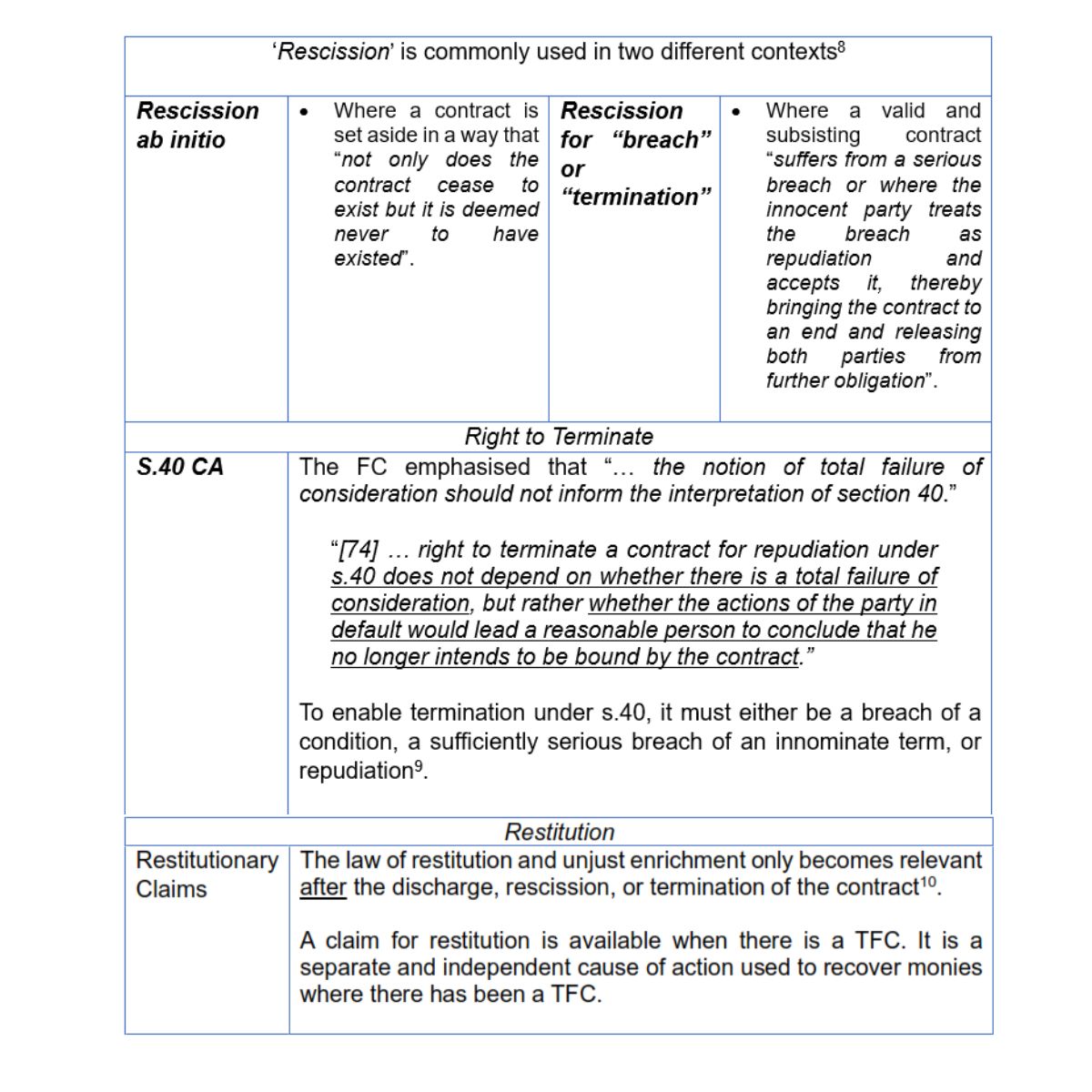
- Applying these principles, the FC found that the Plaintiffs had, at the very least, part-performed their obligations under the Assignment Arrangements – resulting in benefit to the Defendant. Accordingly, there was no TFC [11].
(3) Equitable Bar & The “Architect of Loss”
- The FC further reaffirmed that restitution is an equitable remedy and may be denied for unconscionable conduct.
“[129] … Unconscionable conduct on the part of a claimant would defeat a claim for restitution.”
- Given the Defendant’s involvement in illegal moneylending and his status as an unlicensed moneylender, the Court held that he was the “architect of his own loss”[12], and therefore disentitled from invoking TFC to obtain restitution.
(4) Prospective Effect
- To preserve commercial certainty and avoid reopening cases decided on the earlier Berjaya position, the FC held that the clarified test would apply prospectively only[13].
Key Takeaways
TFC remains a narrow restitutionary doctrine, part-performance negates restitution
Contractual termination and restitution are distinct causes of action and should not be conflated
Berjaya is no longer good law for the test of TFC
Unconscionable conduct may bar restitutionary relief
More than overruling the Berjaya test, Lim Swee Choo recalibrates the boundary between contractual remedies and restitution, and restores doctrinal clarity to Malaysian law.
[1] Para [165] of Lim Swee Choo & Anor v Ong Koh Hou @ Won Kok Fong [2025] 6 MLJ 327
[2] Para [159]
[3] Para [28]
[4] Para [29]
[5] Para [30]
[6] Para [63]
[7] Para [66]
[8] Para [175]
[9] Para [175(c)]
[10] Para [175(d) & (e)]
[11] Para [151]
[12] Para [128] & [129]
[13] Para [174]

This article is prepared by Amanda Yap (Associate).
Amanda Given is an Associate at Daniel & Wong, where she is a part of the firm’s Dispute Resolution department, specialising in civil, corporate and commercial litigation.
Our Dispute Resolution practice specialises in high-stakes civil, commercial and corporate disputes, including shareholders’ disputes, breach of contract, and debt recovery. We have experience representing clients at all levels of the Malaysian Courts, providing strategic and commercially sensible solutions to complex legal challenges.
If you require advice or representation in a legal dispute, please reach out to our team via our contact page.
Disclaimer: The content of this article is intended for general informational purposes only and does not constitute formal legal advice. Please refer to the reported decision in Lim Swee Choo & Anor v Ong Koh Hou @ Won Kok Fong [2025] 6 MLJ 327 for the complete decision and reasoning.
If you found this article useful, please feel free to download the PDF document in the link here.
