
Disputes Digest | Federal Court Clarifies Jet-Tech and the “Affairs of the Company” Requirement in Minority Oppression Claims
Overview
In the recent decision of ISM Sendirian Berhad v Queensway Nominees (Asing) Sdn Bhd & Ors, the Federal Court (“FC”) revisited the scope of minority oppression under section 181 of the Companies Act 1965 (“CA 1965”) [now section 346 of the Companies Act 2016].
The appeal centred on a recurring issue in shareholder disputes: whether a breach of a shareholders’ agreement can sustain a statutory oppression claim.
In clarifying its earlier decision in Jet-Tech Materials Sdn Bhd & Anor v Yushiro Chemical Industry Co Ltd & Ors [2013] 2 CLJ 277 (“Jet-Tech”), the FC reaffirmed that to sustain a claim under s.181 of the CA 1965, “the conduct complained of must relate to or be a matter in the company’s affairs”[1].
The decision reinforces the distinction between private contractual disputes between shareholders and statutory oppression claims grounded in corporate conduct.
Background
The dispute arose out of a joint venture (“JV”) for an integrated commercial development in Kuala Lumpur known as the “Imbi Project”.
- The Appellant, ISM Sendirian Berhad (“ISM”), owned by Dato’ Ray Cheah (“Dato Ray”) and his wife, held a 30% minority equity stake in five JV companies incorporated to acquire 11 parcels of land for the project.[2]The remaining 70% majority stake was held by the 6th Respondent, MPHB Capital Berhad (“MPHB”).
- The five JV companies (1st – 5th Respondents) were structured as single-purpose vehicles, intended solely for land acquisition for the project rather than ongoing commercial operations[3].
- Although a draft shareholders’ agreement was prepared, it was never executed. The parties proceeded on the mutual understanding that they were bound by an oral agreement.[4]
The dispute concerned funding obligations[5]:
- ISM contended that the funding was split into cash and loan components, limiting its obligation to 30% of the cash portion (approximately 9% of the total acquisition costs).
- MPHB countered that funding obligations must strictly follow a 30:70 equity-based contribution across the board.
Following this disagreement, ISM commenced proceedings under s.181 of the CA 1965[6] alleging, amongst others, minority oppression, including funding demands, dilution via rights issues, and the imposition of interest on shareholder advances.
MPHB counterclaimed, amongst others, seeking a judicial declaration that the JV arrangement had been lawfully terminated by reason of ISM’s alleged breach of funding obligations, alongside claims for interest and opportunity costs[7].
High Court (“HC”) & Court of Appeal (“CA”) Decision
The HC found in ISM’s favour on three out of the five grounds. The remaining two grounds were dismissed, and no appeal was pursued against those findings. [8]
The CA reversed this decision, holding that the core dispute concerned the oral shareholders’ agreement between ISM and MPHB. As it did not relate to the “affairs of the company”, it was a private matter falling outside the statutory scope of s.181 of the CA 1965. [9]
Leave Questions at FC
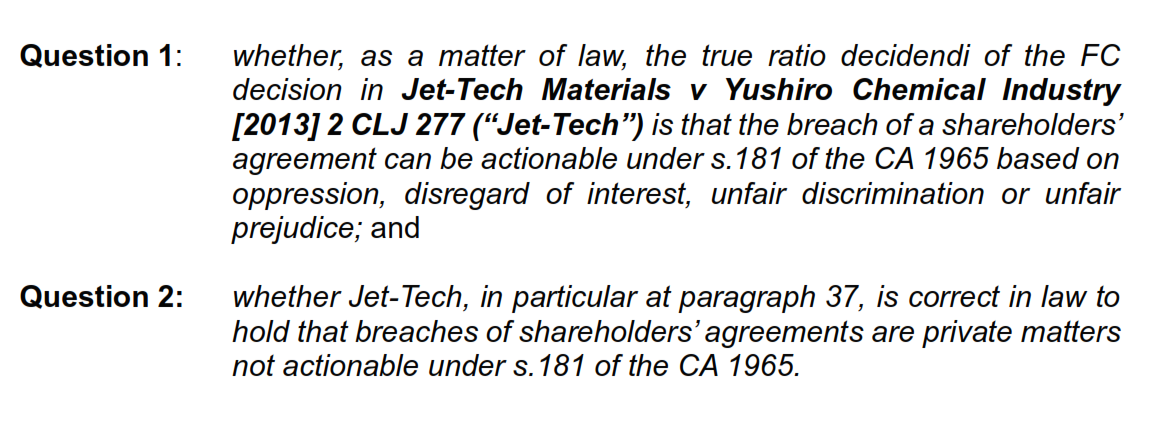
The FC essentially granted leave on two questions [10]: –
Decisions & Key Findings
The FC dismissed both of the Appellant’s appeals and found no appealable error warranting appellate intervention.
(1) The Scope of Jet-Tech & “Affairs of the Company”
The FC undertook a close examination of Jet-Tech, in particular, on paragraph 37.
- The FC reaffirmed that a claim under s.181 of the CA 1965 requires that the conduct complained of must relate to the “affairs of the company”. In doing so, it clarified that Jet-Tech does not establish a blanket prohibition against oppression claims founded on breaches of shareholders’ agreements, and that paragraph 37 must be read in its factual context.
“[70] … there is no express pronouncement or indication in paragraph 37 or any part of the grounds of judgment that any breach of the shareholders’ agreement is not actionable under section 181 of the CA 1965”.
- The critical inquiry is whether the conduct complained of, in substance, relates to the affairs of the company.
- The phrase “affairs of the company” is broad and encompasses, amongst others, capital structure, dividend policy, voting rights, and generally “all matters which may come before the board for consideration”.[11] However, this broad formulation does not extend to purely inter se disputes between shareholders.
- The FC drew a clear distinction: “the company’s affairs cannot be equated with those of its shareholders”. Private arrangements remain a matter for private law remedies, if any[12].
- Applying these principles, the FC held that the principle of law in paragraph 37 of Jet-Tech is correct and its application is inherently fact-sensitive. Accordingly, Question 2 was answered in the affirmative. [13]
- On the facts, the five JV companies were passive special purpose vehicles with limited operational activity, incorporated solely for land acquisition, with no substantive business operations. The FC agreed with the CA that, in light of the nature of the JV companies as passive holding vehicles, the dispute did not concern the “affairs of the company”.[14]
- In these circumstances, the FC held that the requirement of conduct relating to the “affairs of the company” was not satisfied and the oppression claim under section 181 could not be sustained.[15]
(2) Establishing a Quasi-Partnership
The FC rejected the Appellant’s alternative argument that the JV amounted to a “quasi-partnership” capable of invoking equitable standards of fairness.
- A quasi-partnership requires a foundation of personal relationship, mutual trust, and confidence, typically arising from prior or long-standing dealings.[16]
- On the facts, ISM and MPHB had no prior dealings or business transactions, and their dealings in relation to the JV were limited and commercial in nature[17].
- The JV was negotiated and structured as an arm’s length transaction between business entities, where MPHB treated it purely as a standard commercial investment proposal.
- Accordingly, the factual threshold for a quasi-partnership was not met, and equitable considerations were not engaged.[18]
Key Takeaways
Scope of S.181 of the CA 1965 (now s.346 CA 2016) Clarified
Minority oppression is only engaged where the impugned conduct relates, in substance, to the affairs of the company, not merely inter se shareholder disputes.
Contractual breaches do not equate to oppression
A breach of a shareholders’ agreement does not, without more, constitute oppression. The critical inquiry is whether the conduct, in substance, affects “affairs of the company”.
Substance over form governs the analysis
The Courts will examine the substance of the complaint rather than how it is pleaded or labelled.
SPV structure limits oppression claims
Where JV companies function as passive special-purpose vehicles with no substantive business operations, disputes are more likely to be characterised as private commercial disagreements.
Quasi-Partnership remains a high-threshold exception
Equitable intervention requires clear evidence of relational trust and dependency. Arm’s length commercial dealings, even in a JV context, will generally not suffice.
Conclusion
The FC’s decision confirms that paragraph 37 in Jet-Tech should not be read as establishing a categorical exclusion of minority oppression claims simply because the dispute concerns a shareholders’ agreement.
The critical inquiry remains whether, in substance, the impugned conduct relates to the “affairs of the company” under s.181 of the CA 1965, in which case shareholders’ agreement matters could still be the subject matter of a claim under s.181.
Ultimately, the ruling turns on characterisation: whether the alleged wrong implicates the “affairs of the company” or remains a private dispute between shareholders.
[1] Para [70] of ISM Sendirian Berhad v Queensway Nominees (Asing) Sdn Bhd & Ors
[2] Paras [23] – [25]
[3] Para [79]
[4] Para [31], [36], [40]
[5] Paras [32] – [33]
[6] Para [34 (a) – (e)]
[7] Para [35]
[8] Paras [36] – [39]
[9] Paras [40] – [4]
[10] Para [3 (i) & (ii)]
[11] Paras [66] – [67]
[12] Paras [68]
[13] Para [78]
[14] Para [79]
[15] Para [81]
[16] Para [85], [86], [90]
[17] Para [88] – [91]
[18] Para [91]

This article is prepared by Amanda Yap (Associate).
Amanda Given is an Associate at Daniel & Wong, where she is a part of the firm’s Dispute Resolution department, specialising in civil, corporate and commercial litigation.
Our Dispute Resolution practice specialises in high-stakes civil, commercial and corporate disputes, including shareholders’ disputes, breach of contract, and debt recovery. We have experience representing clients at all levels of the Malaysian Courts, providing strategic and commercially sensible solutions to complex legal challenges.
If you require advice or representation in a legal dispute, please reach out to our team via our contact page.
Disclaimer: The content of this article is intended for general informational purposes only and does not constitute formal legal advice. Please refer to the Grounds of Judgment in the Federal Court Civil Appeal No. 02(f)-9-03/2025(W).
If you found this article useful, please feel free to download the PDF document in the link here.
