
Disputes Digest | Can a Malaysian Court Force an Unwilling Defendant to Apologise?
Overview
In the recent decision of Tan Sing How & Ors v Ng Ze Xuan (Civil Appeal No.: B-02(W)-659-04/2024), the Court of Appeal (“CA”) addressed, amongst others, the Court’s jurisdiction to order the publication of an apology, as well as the assessment of damages arising from successive defamatory publications.
While the CA affirmed the finding of liability and rejected the pleaded defences, the CA set aside the High Court’s order for an apology to be issued[1] and further reduced the aggregate award of RM 600,000.00 to a global sum of RM 100,000.00.
Significantly, two written judgments were issued concerning the availability of apologies as a remedy in defamation proceedings. The Main Judgment was delivered by YA Dato’ Ong Chee Kwan JCA (with whom YA Datuk Mohamed Zaini bin Mazlan JCA concurred), while YA Tuan Muniandy A/L Kannyappan JCA delivered a Supporting Judgment expressing additional observations on the issue. They may be briefly summarised as follows.
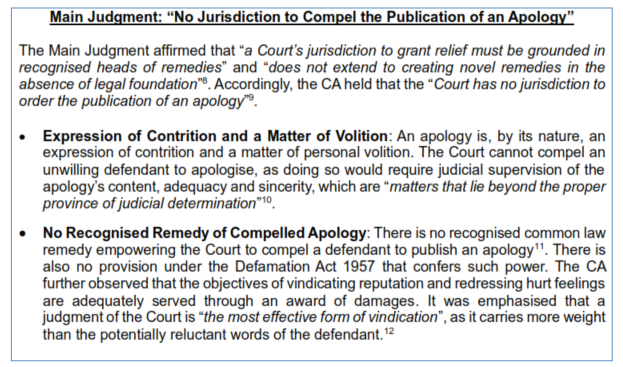
- The Main Judgment: Held that “a Court’s jurisdiction to grant relief must be grounded in recognised heads of remedies, whether statutory, common law or equitable” and that the Court has no jurisdiction to order the publication of an apology[2].
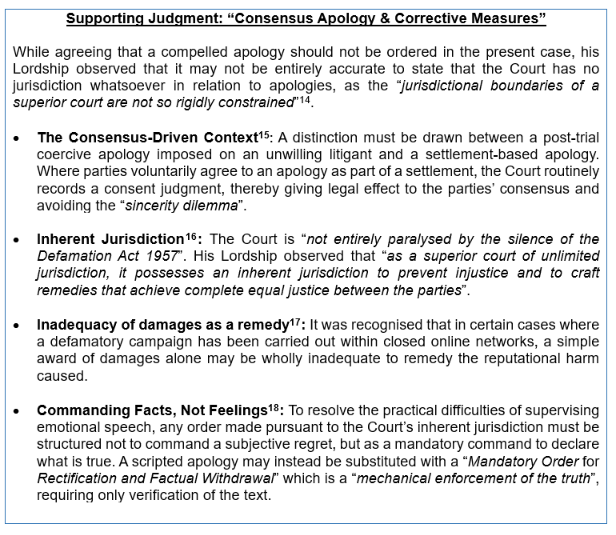
- The Supporting Judgment: Distinguished between compelled expressions of remorse and correction statements. His Lordship observed that, in an appropriate case, a “Mandatory Order for Rectification and Factual Withdrawal” may, in principle, provide an alternative to a scripted apology by requiring the defendant to declare objective facts rather than express subjective remorse. Such an order was described as a “mechanical enforcement of the truth”, requiring only verification of the text[3].
Brief Background Facts
- The Parties:
- TSH and LPK are the founders and directors of Kalysta Sdn Bhd (“Appellants”), an online weight-loss supplement marketing company in Malaysia. NZX (“Respondent”) served as a high-ranking General Agent of Kalysta Sdn Bhd, managing a subgroup of over 400 sales representatives.
- The Dispute:
- Following internal company investigations into the Respondent’s alleged involvement with a separate commercial entity and an unauthorised marketing incident, the Appellants terminated the Respondent’s agency relationship on 26.6.2021. The Appellants also pursued a counterclaim for the return of performance bonuses and account access.
- The Impugned Publications:
- Over a compressed period of eight days between 16.7.2021 and 24.7.2021, the Appellants published a series of seven statements (“Impugned Statements”). These publications were disseminated within closed online networks, such as WeChat and Instagram group chats, where the Respondent was described in terms including “compulsive liar” and “manipulative leader”.[4]
High Court (“HC”) Decision
- The HC found that each of the Impugned Statements bore defamatory meanings and adopted a segmented approach in assessing damages, treating each Impugned Statement as giving rise to separate liability by reference to their respective publications made on different occasions[5].
- The HC awarded separate blocks of general and aggravated damages against each Appellant for the respective Impugned Statements, culminating in a cumulative liability of RM600,000.00.
- Pertinently, having found the Impugned Statements to be defamatory, the HC further ordered the Appellants to tender an apology to the Respondent based on the language and contents proposed by her.[6]
- Dissatisfied, the Appellants appealed against the HC’s decision to the CA.
Decisions & Key Findings
The CA affirmed the HC’s decision that the Impugned Statements were defamatory of the Respondent and rejected the pleaded defences. However, the CA set aside the HC’s order for an apology to be issued[7] and reduced the quantum of damages awarded.
(1) Court’s Jurisdiction to Compel an Apology as a Remedy
- The Main Judgment essentially held that the Court has no jurisdiction to order the publication of an apology under the law.
- On the other hand, the Supporting Judgment, while concurring that no apology should be ordered on the facts, contemplated the possibility that the Court may, in appropriate cases, exercises its inherent jurisdiction to order corrective non-monetary remedies[13].
(2) Assessment of Damages: Cases of Successive Publications
Separately, the CA also reduced the quantum of damages, adopting a global assessment and holding that the Impugned Statements formed part of a continuous course of conduct and should not be assessed in a fragmented or duplicative manner.
- Continuous Course of Defamation[19]: Although each defamatory publication constitutes a separate cause of action, the CA held that the seven Impugned Statements should not be treated in a fragmented manner. Published within a compressed timeframe and arising from the same underlying allegations, they formed part of a coherent narrative. A global assessment of damages, therefore, better reflected the cumulative nature of the reputational harm and avoided artificial fragmentation, duplicative compensation and mechanical multiplication of awards.
- Absence of Proven Substantial Harm[20]: While defamation is actionable per se, the CA found no clear evidence of financial loss or significant reputational impact. Having regard to comparable authorities, the CA accordingly considered a global award of RM 100,000.00 to be fair, reasonable and proportionate in the circumstances.
Key Takeaways
Court Cannot Compel an Apology:
Even where a plaintiff succeeds at trial, the Court cannot compel an unwilling defendant to publish an apology. An apology remains a voluntary expression of remorse rather than a coercive post-trial remedy.
Corrective Relief May be Worth Considering:
In cases involving online publications or closed online networks, parties may consider seeking corrective statements, withdrawals or retractions, particularly in light of the observations made in the Supporting Judgment.
Global Assessment of Damages in Related Publications:
Where multiple defamatory publications form part of a single continuous course of conduct arising from the same underlying allegations, the Court may adopt a global assessment of damages to avoid fragmented or duplicative awards.
Conclusion
The decision is significant for clarifying the limits of remedial relief in Malaysian defamation law.
The Main Judgment reaffirmed that a compelled apology is not a permissible post-trial remedy and that the Court’s jurisdiction must be grounded in recognised heads of relief.
The Supporting Judgment, meanwhile, highlights the possibility that corrective non-monetary remedies may be available in appropriate cases, particularly where reputational harm arises within closed online networks.
[1] Para 94 of the Main Judgment (Civil Appeal No.: B-02(W)-659-04/2024, Encl 71, “Main Judgment”)
[2] Para 67 & 68 of the Main Judgment
[3] Para 8 & 9 (Civil Appeal No.: B-02(W)-659-04/2024, Encl 72, “Supporting Judgment”)
[4] Para 7 – 26 of the Main Judgment
[5] Para 27 & 70 of the Main Judgment
[6] Para 54 of the Main Judgment
[7] Para 94 of the Main Judgment
[8] Para 67 of the Main Judgment
[9] Para 68 of the Main Judgment
[10] Para 56 of the Main Judgment
[11] Para 55 of the Main Judgment
[12] Para 64 & 66 of the Main Judgment
[13] Para 6 of the Supporting Judgment
[14] Para 3 of the Supporting Judgment
[15] Para 4 & 5 of the Supporting Judgment
[16] Para 6 of the Supporting Judgment
[17] Para 7 of the Supporting Judgment
[18] Para 8 & 9 of the Supporting Judgment
[19] Para 72 – 81 of the Main Judgment
[20] Para 83 – 91 of the Main Judgment


This article is prepared by Nicholas Yap (Senior Associate) and Amanda Yap (Associate).
Nicholas Yap Chun Yew is a Senior Associate at Daniel & Wong within the Dispute Resolution department. He specialises in civil, corporate and commercial litigation, with a focus on corporate and shareholder disputes, fraud and asset recovery, defamation and insolvency matters.
Amanda Given is an Associate at Daniel & Wong, where she is a part of the firm’s Dispute Resolution department, specialising in civil, corporate and commercial litigation.
Our Dispute Resolution practice specialises in high-stakes civil, commercial and corporate disputes, including shareholders’ disputes, breach of contract, and debt recovery. We have experience representing clients at all levels of the Malaysian Courts, providing strategic and commercially sensible solutions to complex legal challenges.
If you require advice or representation in a legal dispute, please reach out to our team via our contact page.
Disclaimer: The content of this article is intended for general informational purposes only and does not constitute formal legal advice. Please refer to the Grounds of Judgment in the Federal Court Civil Appeal No. 02(f)-9-03/2025(W).
If you found this article useful, please feel free to download the PDF document in the link here.
