
Disputes Digest | Malaysia’s Cross-Class Cram Down: Can a Dissenting Creditor be placed in a Standalone Class?
Overview
Can a company place a hostile creditor into a class of its own, and seek to cram it down under a proposed scheme of arrangement (“PSOA”)?
This issue arose in KL Petrogas Sdn Bhd v SA Puncak Management Sdn Bhd [2026] MLJU 1663, one of the first substantive judicial considerations of the cross-class cram down regime introduced under S.368D of the Companies Act 2016 (“CA 2016”).
Under a conventional scheme of arrangement in S.366(3) CA 2016, each creditor class must approve the PSOA by a majority of at least 75% in value of the creditors present and voting in that class. Consequently, a creditor holding more than 25% of the debt within a creditor class may effectively block the statutory majority, giving it a practical veto over the PSOA.[1]
That position appears to have changed with S.368D CA 2016[2], introduced via the Companies (Amendment) Act 2024 (“2024 Amendment”). Subject to the statutory requirements and safeguards under S.368D being satisfied, the Court may now sanction a scheme notwithstanding the rejection by one or more creditor classes.
Briefly, in KL Petrogas, the respondent (“SA Puncak”), the largest unsecured creditor holding approximately 29% of the unsecured debt, made clear that it would oppose any scheme proposed by the applicant (“KL Petrogas”). KL Petrogas responded by placing SA Puncak into a separate creditor class, seeking to invoke the cross-class cram down mechanism under S.368D CA 2016.[3]
The High Court (“HC”) described this as an “audacious move” [4]. Nevertheless, the HC granted the convening order, finding no obvious roadblock or unfairness warranting refusal at that stage[5].
However, the HC did not determine whether SA Puncak could ultimately be crammed down under S.368D CA 2016. Questions concerning the bona fides of the class composition and the parties’ conduct were expressly left to be considered at the sanction stage[6].
This article examines key aspects of the HC’s decision:
- The operation of the 75% statutory threshold under S.366 and S.368D CA 2016;
- The fairness standard applicable to a cross-class cram down; and
- The Court’s approach to deliberate creditor class composition in facilitating a cross-class cram down.
Background
- KL Petrogas encountered financial difficulties following enforcement action by SA Puncak under financing facilities exceeding RM22 million. SA Puncak subsequently terminated the financing facilities and appointed Receivers and Managers over KL Petrogas pursuant to the debenture.[7]
- In separate proceedings (Suit 787), the High Court held that certain agreements relating to the pre-factoring facility were unenforceable and that the debenture was void to the extent it secured that facility. Accordingly, SA Puncak was treated as an unsecured creditor for KL Petrogas’s proposed restructuring. The decision remains subject to appeal.[8]
- Against this backdrop, KL Petrogas sought an order from the HC to convene meetings of its creditors for the purposes of considering and approving a scheme of arrangement.
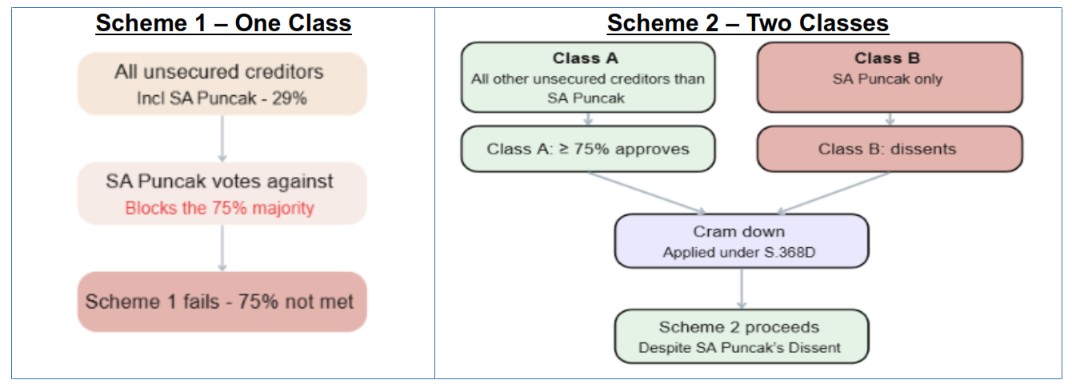
- Under the initial proposed scheme (“Scheme 1”), all unsecured creditors were placed in a single class and would be repaid on a pari passu basis.
- However, SA Puncak, holding approximately 29% of the unsecured debt, made clear that it intended to vote against Scheme 1.[9]
- To overcome this, KL Petrogas proposed a revised scheme (“Scheme 2”) by invoking the cross-class cram down regime under S.368D CA 2016, as illustrated below.
- The strategy for Scheme 2 was straightforward: if Class A achieved the requisite 75% statutory majority, KL Petrogas could seek to invoke the cram down mechanism under S.368D CA 2016 to bind Class B notwithstanding SA Puncak’s dissent. The HC described this as an “audacious move”[10].
- The question before the HC was whether the proposed cross-class structure presented an obvious “roadblock” or abuse of process such that the HC should refuse to convene the creditor meetings.
HC Decision & Key Findings
The HC granted the convening order after considering comparative jurisprudence from the UK, US and Singapore. Central to the HC’s reasoning was the legislative purpose underlying S.368D CA 2016.[11] As the HC observed:
“…the very objective and purpose of the cram down legislation, to prevent a recalcitrant creditor from vetoing a beneficial scheme that is wanted by the other creditors”[12].
The HC’s reasoning can broadly be distilled as follows: –
(1) The 75% Statutory Threshold [13]
Conventional Scheme, S.366 CA 2016
Cross-class Cram Down, S.368D CA 2016
- S.366(3) requires each creditor class to independently satisfy the statutory threshold, i.e., approval by a majority representing at least 75% in value of the creditors of that class present and voting.
- Consequently, a creditor holding more than 25% of the debt within a class could, by itself, prevent that class from achieving the statutory threshold, effectively creating a blocking position.
- S.368D appears to be the exception to the conventional scheme.
- It applies where:[14]
(a) a vote has taken place at a relevant meeting convened under S.366(1) CA 2016;
(b) creditors are placed into two or more classes;
(c) at least one class (“Assenting Class”) has approved the scheme by satisfying the 75% threshold under S.366(3); and
(d) at least one class (“Dissenting Class”) has not approved the scheme by the requisite statutory majority.
- Where the statutory requirements and safeguards under S.368D(3) and (4) are satisfied, the Court may approve the scheme under S.368D(2), notwithstanding the rejection by the Dissenting Class.
- Accordingly, the Dissenting Class’s protection shifts from an absolute voting veto to judicial oversight through the statutory safeguards under S.368D.
(2) The Applicable ‘Fairness’ Test
- Under a conventional scheme of arrangement[15], the Court generally applies the “limited rationality” test, i.e., whether an intelligent and honest creditor, acting in their own interest, could reasonably approve the scheme.
- However, the HC held that this test is not appropriate in the context of cross-class schemes[16]. Unlike a conventional scheme, a cross-class cram down necessarily involves a creditor class that has not approved the proposed scheme by the requisite statutory majority. As such, fairness cannot simply be assumed from creditor approval.
- The HC further observed that the “limited rationality” test merely serves as a “cross-check” to an affirmative vote of the creditor class and therefore has no application where the Dissenting Class has not approved the scheme.
- Instead, the HC held that the appropriate inquiry is whether the restructuring achieves a fair distribution of the benefits it generates among the affected creditor classes[17].
- Accordingly, the Court must consider (1) whether the restructuring benefits are fairly distributed among creditor classes and (2) whether the dissenting class is treated fairly and equitably.
- On the facts, the HC found no unfairness at the convening stage. Scheme 2 afforded identical treatment to both classes of unsecured creditors, with all creditors entitled to full repayment on a pari passu [18]
(3) Deliberate Class Composition is not, at the Convening Stage, an Automatic Abuse of Process (S.368 CA 2016)[19]
- SA Puncak argued that placing it into a separate class solely to facilitate a cram down amounted to a “capricious use” of S.368D CA 2016 and an abuse of process. The question before the HC was whether the proposed class composition constituted a “roadblock” or whether Scheme 2 was proposed in bad faith or otherwise amounted to an abuse of process such that the convening order should be refused.
- While recognising that such an argument may be correct under the conventional scheme framework, the HC held that the legal landscape had changed with S.368D CA 2016. At the convening stage, the HC observed that the purpose of the regime is to prevent, in appropriate cases, a dissenting creditor from exercising an unjustified veto over an otherwise beneficial restructuring.
- In this regard, the HC held that it could “see no reason why a company may not take advantage of the cram down provisions to cram down a hostile creditor with a veto right in the appropriate case.”
- Nevertheless, the HC emphasised that this did not amount to a final determination that the proposed class composition was permissible. Whether the proposed class composition was ultimately bona fide and whether Scheme 2 satisfied the statutory safeguards under S.368D CA 2016 remained fact-sensitive questions to be determined at the sanction stage[20].
Key Takeaways
S.368D CA 2016 and the 75% Statutory Threshold
Under the conventional scheme, each creditor class must independently satisfy the 75% statutory threshold under S.366(3) CA 2016, which allows a creditor holding more than 25% of a class’s debt to effectively block the scheme.
Under S.368D, however, a scheme may proceed notwithstanding the rejection of a dissenting class, provided that at least one creditor class has approved the scheme by the requisite statutory majority and the statutory safeguards are satisfied.
The ‘fairness’ standard under S.368D CA 2016 departs from the conventional “limited rationality” test.
The Court must determine whether restructuring benefits are fairly distributed among creditor classes and whether the dissenting class is treated fairly and equitably.
Deliberate class composition is not inherently impermissible at the convening stage.
A scheme company may, in an appropriate case, structure creditor classes in a manner that facilitates the operation of S.368D CA 2016. However, the fairness of such structuring, the parties’ bona fides, and any potential abuse of process remain subject to scrutiny at the sanction stage.
Conclusion
The decision provides early judicial guidance on Malaysia’s cross-class cram down regime, clarifying that the conventional “limited rationality” test does not apply in the S.368D context and that deliberate creditor class composition is not, by itself, impermissible at the convening stage. However, whether such restructuring is bona fide and whether the statutory safeguards are ultimately satisfied remain matters for determination at the sanction stage.
More broadly, the decision highlights the significance of S.368D in addressing the limitations of conventional schemes, where a single dissenting creditor holding a blocking position could prevent an otherwise viable restructuring from proceeding. By limiting such blocking power while preserving judicial oversight, the regime enables distressed companies to pursue genuine restructuring efforts consistent with the legislative objective of promoting corporate rescue.
[1] Para [6] – [11] of KL Petrogas Sdn Bhd v SA Puncak Management Sdn Bhd [2026] MLJU 1663
[2] Para [74] – [75], [121] – [126]
[3] Para [7] – [11], [67] – [71]
[4] Para [71]
[5] Para [125] – [126] & [134]
[6] Para [133]
[7] Para [12] – [23]
[8] Para [24] – [43]
[9] Para [44] – [70]
[10] Para [71] – [72]
[11] Paras [121] – [125]
[12] Para [125]
[13] Para [7] – [11]; [74] – [82]
[14] Para [77]
[15] Para [84] – [85]
[16] Para [98] & [102]
[17] Para [87], [91] – [110]
[18] Para [115] – [116] & [134]
[19] Para [117] – [126] (in particular: para [119], [123] – [125])
[20] Para [133]


This article is prepared by Thevan Aruljothi (Associate) and Amanda Yap (Associate).
Thevan Aruljothi is an Associate at Daniel & Wong, where he is part of the firm’s Dispute Resolution department. He specialises in corporate and commercial litigation, with a principal focus on shareholder and corporate disputes, fraud and asset recovery, contractual disputes, insolvency and winding up matters.
Amanda Given is an Associate at Daniel & Wong, where she is a part of the firm’s Dispute Resolution department, specialising in civil, corporate and commercial litigation.
Our Dispute Resolution practice specialises in high-stakes civil, commercial and corporate disputes, including shareholders’ disputes, breach of contract, and debt recovery. We have experience representing clients at all levels of the Malaysian Courts, providing strategic and commercially sensible solutions to complex legal challenges.
If you require advice or representation in a legal dispute, please reach out to our team via our contact page.
Disclaimer: The content of this article is intended for general informational purposes only and does not constitute formal legal advice. Please refer to the Grounds of Judgment in the Federal Court Civil Appeal No. 02(f)-9-03/2025(W).
If you found this article useful, please feel free to download the PDF document in the link here.
