

M&A Bytes: Material Adverse Change Clauses – The Buyer’s Last-Minute Exit Route
Between signing and completion, circumstances can change dramatically. One sudden event can give a buyer the legal right to walk away — are you prepared for it?
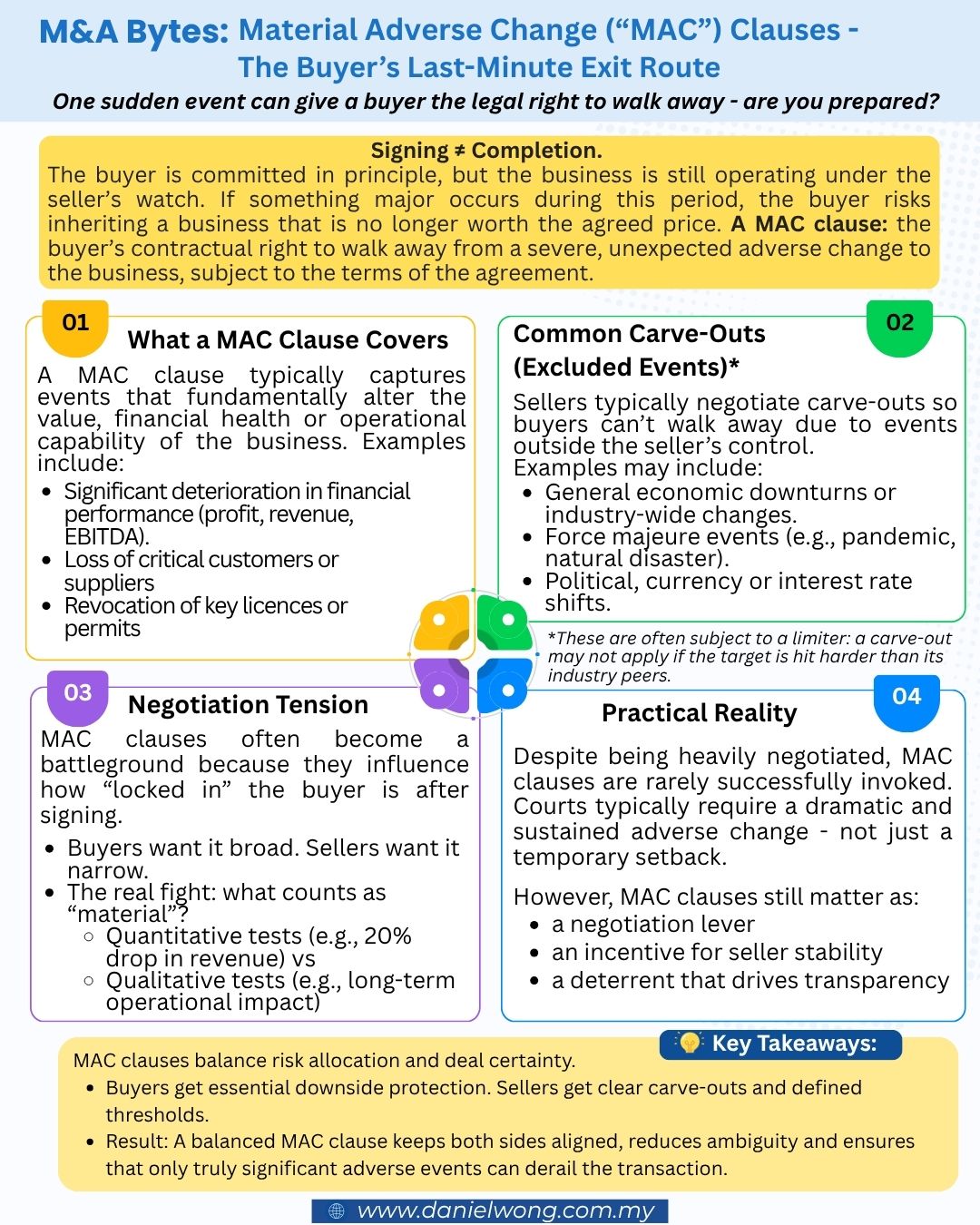
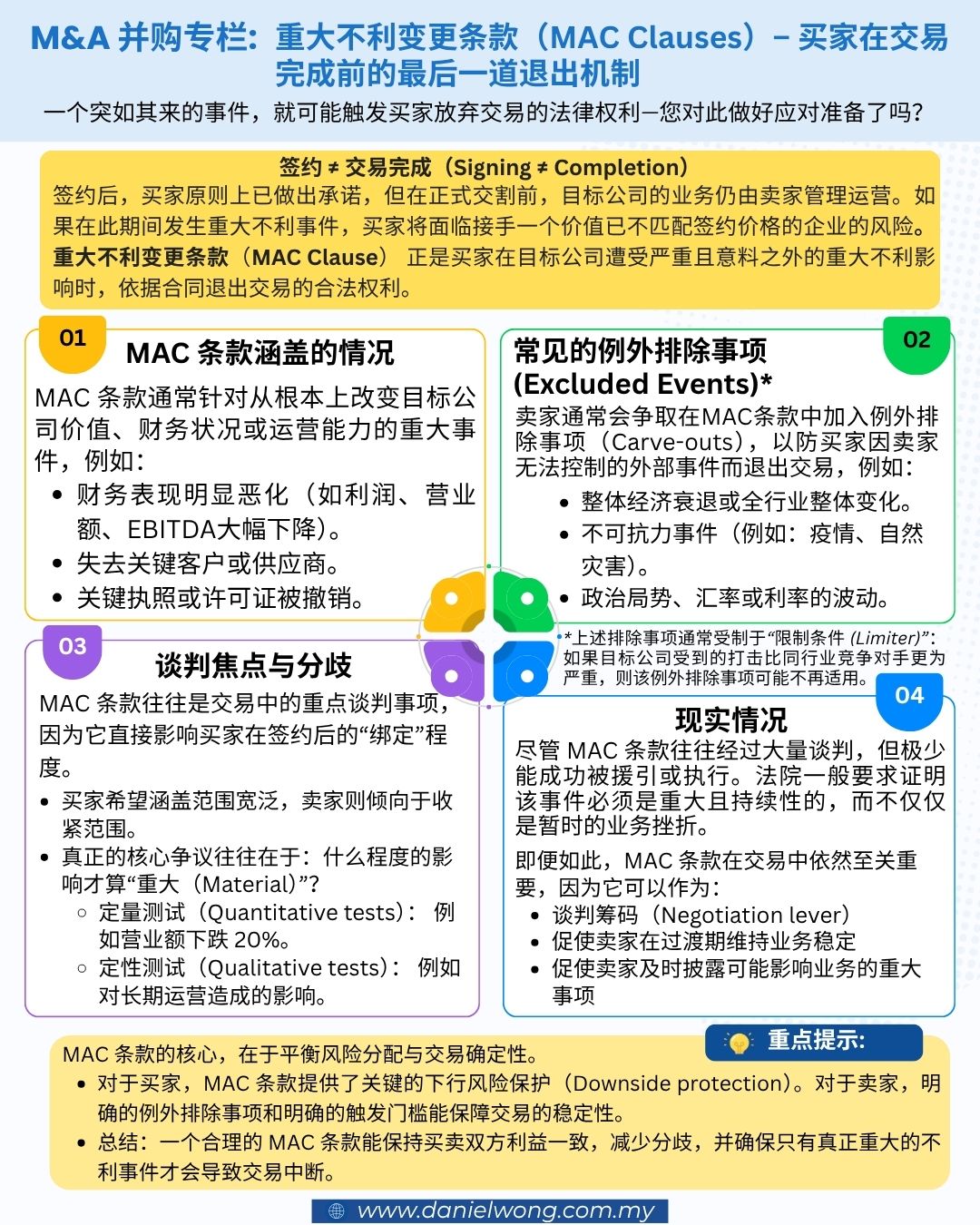
The buyer is committed in principle, but the business remains under the seller’s watch. If something major occurs during this period, the buyer risks inheriting a business that is no longer worth the agreed price.
A material adverse change (“MAC”) clause gives the buyer a safety valve, a contractual right to walk away if the target suffers a severe, unexpected negative event.
Understanding how MAC clauses work and how they’re limited is essential for both buyers and sellers.
What a MAC clause covers?
A MAC clause typically captures events that fundamentally alter the value, financial health or operational capability of the business.
Examples include:
- Significant deterioration in financial performance (profit, revenue, EBITDA).
- Loss of critical customers or suppliers
- Revocation of key licences or permits
Common Carve-Outs (Excluded Events):
Sellers typically negotiate carve-outs so buyers can’t walk away due to events outside the seller’s control.
These carve-outs typically include:
- General economic downturns or industry-wide changes.
- Force majeure events (e.g., pandemic, natural disaster).
- Changes in law or accounting standards.
- Political events, currency fluctuations, interest rate changes.
These are often subject to a limiter – if the target is disproportionately affected compared to others in the industry, the carve-out may not apply.
Negotiation Tension
MAC clauses often become a battleground because they influence how “locked in” the buyer is after signing.
- Buyers want broad, flexible MAC language to preserve optionality, whereas Sellers want narrow, specific thresholds to ensure deal certainty.
- The biggest fight: what counts as “material?”
- Quantitative tests (e.g., 20% drop in revenue) vs Qualitative tests (impact on long-term operations).
Practical Reality
Despite being heavily negotiated, MAC clauses are rarely invoked successfully.
Courts typically require there to be a dramatic, sustained, long-term adverse change and not just a temporary setback.
However, MAC clauses still play an important psychological and strategic role:
- They act as a negotiation lever for buyers if something bad happens pre-completion.
- They encourage sellers to maintain business stability during the interim period.
- They serve as a deterrent, ensuring transparency about any emerging issues.
🔑 Key Takeaway:
MAC clauses sit at the crossroads of risk allocation and deal certainty.
A well-drafted MAC clause protects the buyer without creating excessive uncertainty for the seller. It clarifies what truly counts as a deal-breaking event and avoids disputes at the most sensitive stage of the transaction.
- For buyers, MAC clauses provide essential downside protection.
- For sellers, clear carve-outs and defined thresholds preserve deal stability.
A balanced MAC clause keeps both sides aligned, reduces ambiguity and ensures that only truly significant adverse events can derail the transaction.
In Essence:
Disclaimer: The content of this article is intended for general informational purposes only and does not constitute formal legal advice.
Our Corporate team regularly advises local and international corporations on mergers and acquisitions (M&A), cross-border transactions, joint ventures, and corporate restructuring. We also provide comprehensive support for shareholders’ agreements and general commercial advisory to help businesses navigate the Malaysian regulatory landscape.
For legal assistance or further inquiries regarding your corporate matters, please feel free to contact us.
