

Disputes Digest | Tracing Misappropriated Funds into an Appreciating Asset
Overview
Where a director misappropriates a company’s funds, and those funds are used to acquire an asset which subsequently increases in value, is the company’s recovery confined to the amount originally misappropriated?
In Eramas Konsortium Sdn Bhd v GA Yee Furniture Sdn Bhd[1], the Court of Appeal (“CA”) considered this question in the context of a breach of fiduciary duty, where RM 4.03 million of the company’s misappropriated funds was applied towards the acquisition of a parcel of land which was subsequently sold for RM 25 million.[2]
The CA affirmed that, where misappropriated funds are used to acquire an asset, a plaintiff’s proprietary interest may be traced into that substitute asset, enabling the plaintiff to assert a proportionate beneficial interest in the substitute asset, including any subsequent increase in value[3], rather than being confined to recovery of the original sum.
The decision therefore illustrates the operation of equitable tracing where misappropriated funds have been converted into a substitute asset, in circumstances involving a breach of fiduciary duty and the imposition of a constructive trust over the misappropriated funds and property.
Brief Background Facts
The Respondent, Ga Yee Furniture Sdn Bhd (“Ga Yee”), was controlled by two shareholder-directors (collectively, the “Directors”), who also controlled Encony Development Sdn Bhd (“Encony”) and Eramas Konsortium Sdn Bhd (“Eramas”).
According to the findings of the High Court (“HC”), the Directors orchestrated transfers totalling approximately RM 9.4 million from Ga Yee to Encony and Eramas, which were characterised as purported loans. The money trail was briefly as follows:-

Following the discovery of the transactions, the Directors resigned and transferred their interest in the relevant companies to third parties. Ga Yee then commenced proceedings seeking, amongst others, recovery of the misappropriated funds, declaration of constructive trust and tracing relief.
The HC found in favour of Ga Yee, holding, amongst others, that the transfers were fraudulent and that Ga Yee was entitled to trace the misappropriated funds into the Property.
Court of Appeal Decision: Spotlight
For purposes of this case digest, we focus on some of the CA’s key findings concerning the transfers and the circumstances leading to the tracing of the funds.
(1) Nature of Transactions – Were They Legitimate?
In rejecting the contention that the transfers were “related-party transactions”, the CA held that Ga Yee, Encony and Eramas were not “related companies” within the meaning of the Companies Act 2016 (“CA 2016”)[4]. Ga Yee, Encony and Eramas were separate legal entities, and the mere fact that the Directors held positions in these companies did not bring them within the statutory definition. Therefore, it did not legitimise the transfers of monies between them[5].
The CA further observed that inter-company loans between companies with common directors are not inherently prohibited under CA 2016, but necessarily attract closer scrutiny given the inherent risk of conflicts of interest and the potential misuse of corporate funds.[6]
The CA affirmed the HC’s finding that the purported “loans” were fraudulent in nature, noting, amongst others, the absence of the essential features of genuine commercial loans and non-compliance with the applicable requirements under the CA 2016.[7]
In affirming the HC’s findings that the Directors had breached their fiduciary duties to, and conspired against Ga Yee, the CA considered the cumulative effect of various circumstances, including their role in authorising and directing the transfers, the purported resolutions approving the transfers, inconsistencies in the audited accounts and their subsequent conduct.[8]
(2) The Money Trail – What Did the Money Become?
The HC found that the transfers were sham transactions disguised as loans and ordered, amongst others, that Eramas pay Ga Yee RM 11,178,313.90 (“RM 11.18m”) pursuant to the tracing process.
Eramas argued that its liability should only be limited to the RM 4,034,917.70 (“RM 4.03m”) that it had originally received from Ga Yee. The CA rejected this approach and affirmed the HC’s reliance on Foskett v McKeown[9] as a leading authority on the equitable principles of tracing, reiterating that:-
…where misappropriated funds were used to acquire a new asset, the claimant’s proprietary interest was not extinguished but may be traced into that substitute asset. The claimant may then elect to assert a proportionate beneficial interest in the asset, including any increase in its value, or alternatively claim an equitable lien to secure repayment of the original amount misapplied.[10]
Importantly, the CA clarified that the tracing exercise does not depend on establishing unconscionability or unjust enrichment. Rather, the pertinent inquiry is whether a proprietary connection between the claimant’s property and the substitute asset can be established.[11]
On the facts, the RM 4.03m transferred from Ga Yee funded approximately 39.1% of the purchase price of the Property. The CA held that Ga Yee’s proprietary right followed that money into the Property and subsequently into the RM 25 million sale proceeds. Ga Yee was therefore entitled to 39.1% of the sale proceeds, amounting to RM 9.775 million. A visualisation of the tracing process is as follows:
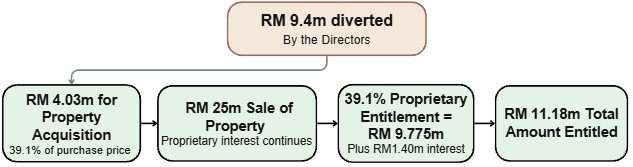
The CA emphasised that this was not treated as a mere “repayment” of the RM 4.03m, but as Ga Yee’s proprietary entitlement to what the RM 4.03m had become.[12]
The CA also distinguished between the proprietary remedy arising from tracing and the personal remedies arising from the breaches of fiduciary duty and conspiracy.[13]
(3) Constructive Trust – Does It Need to be Pleaded?
Notably, in rejecting Eramas’ contention that Ga Yee had failed to plead a sufficient basis for constructive trust relief, the CA held that a constructive trust is not an independent cause of action but an equitable remedy which may be granted where the facts pleaded justify such intervention.
The relevant question was therefore not whether “constructive trust” was specifically pleaded, but whether the material facts establishing a basis for such relief had been pleaded and proved. The CA found that Ga Yee had satisfied this requirement[14].
Conclusion
Eramas Konsortium illustrates the operation of equitable tracing in the context of misappropriated corporate funds following a breach of fiduciary duty. Its significance lies not simply in recovering the monies originally misappropriated, but in determining whether the plaintiff’s proprietary interest can be traced into what those monies became, including the resulting asset and, where applicable, its eventual sale proceeds.
Key Takeaways
Trace the money, not just the loss
Where misappropriated funds are used to acquire an identifiable asset, the plaintiff should consider whether its proprietary interest can be traced into the substitute asset and, where appropriate, its eventual sale proceeds, including any increase in value.
Common directorships warrant closer scrutiny
Inter-company loans between companies are not, in themselves, prohibited, but warrant closer scrutiny given the inherent risks of conflicts of interest and potential misuse of corporate funds.
Constructive trust is an equitable remedy
A constructive trust is not an independent cause of action. The focus is on pleading and proving the material facts supporting the relief.
[1] Civil Appeals No. P-02(NCvC)(W)-1792-10/2024 & P-02(NCvC)(W)-1991-11/2024
[2] ibid, para [62]
[3] ibid, para [67] – [73]
[4] Section 7 of the Companies Act 2016
[5] Eramas Konsortium (n 1), para [21] – [26]
[6] ibid, para [27]
[7] ibid, para [28] – [34]
[8] ibid, para [39] – [48]
[9] [2000] UKHL 29. See also Takako Sakao v Ng Pek Yuen & Anor [2009] 6 MLJ 751 and;
Tay Choo Foo @ Tay Chiew Foo v Tengku Mohd Saad @ Tengku Arifaad bin Tengku Mansur [2008] MYCA 88
[10] Eramas Konsortium (n 1), para [68]
[11] ibid, para [69]
[12] ibid, para [71]
[13] ibid, para [72] – [74]
[14] Eramas Konsortium (n 1), para [55] – [58]


This article is prepared by Natalie Lim (Associate) and Amanda Yap (Associate).
Natalie Lim Tze Thong is an Associate at Daniel & Wong, specialising in corporate and commercial litigation within the firm’s dispute resolution practice group.
Amanda Given is an Associate at Daniel & Wong, where she is a part of the firm’s Dispute Resolution department, specialising in civil, corporate and commercial litigation.
Our Dispute Resolution practice specialises in high-stakes civil, commercial and corporate disputes, including shareholders’ disputes, breach of contract, and debt recovery. We have experience representing clients at all levels of the Malaysian Courts, providing strategic and commercially sensible solutions to complex legal challenges.
If you require advice or representation in a legal dispute, please reach out to our team via our contact page.
Disclaimer: The content of this article is intended for general informational purposes only and does not constitute formal legal advice. Kindly refer to the complete decision and reasoning in Eramas Konsortium Sdn Bhd v Ga Yee Furniture Sdn Bhd (Civil Appeals No. P-02(NCvC)(W)-1792-10/2024 & P-02(NCvC)(W)-1991-11/2024).
If you found this article useful, please feel free to download the PDF document in the link here.
