
M&A Bytes: Warranties vs Indemnities – Understanding the Difference Can Save (or Lose) Millions
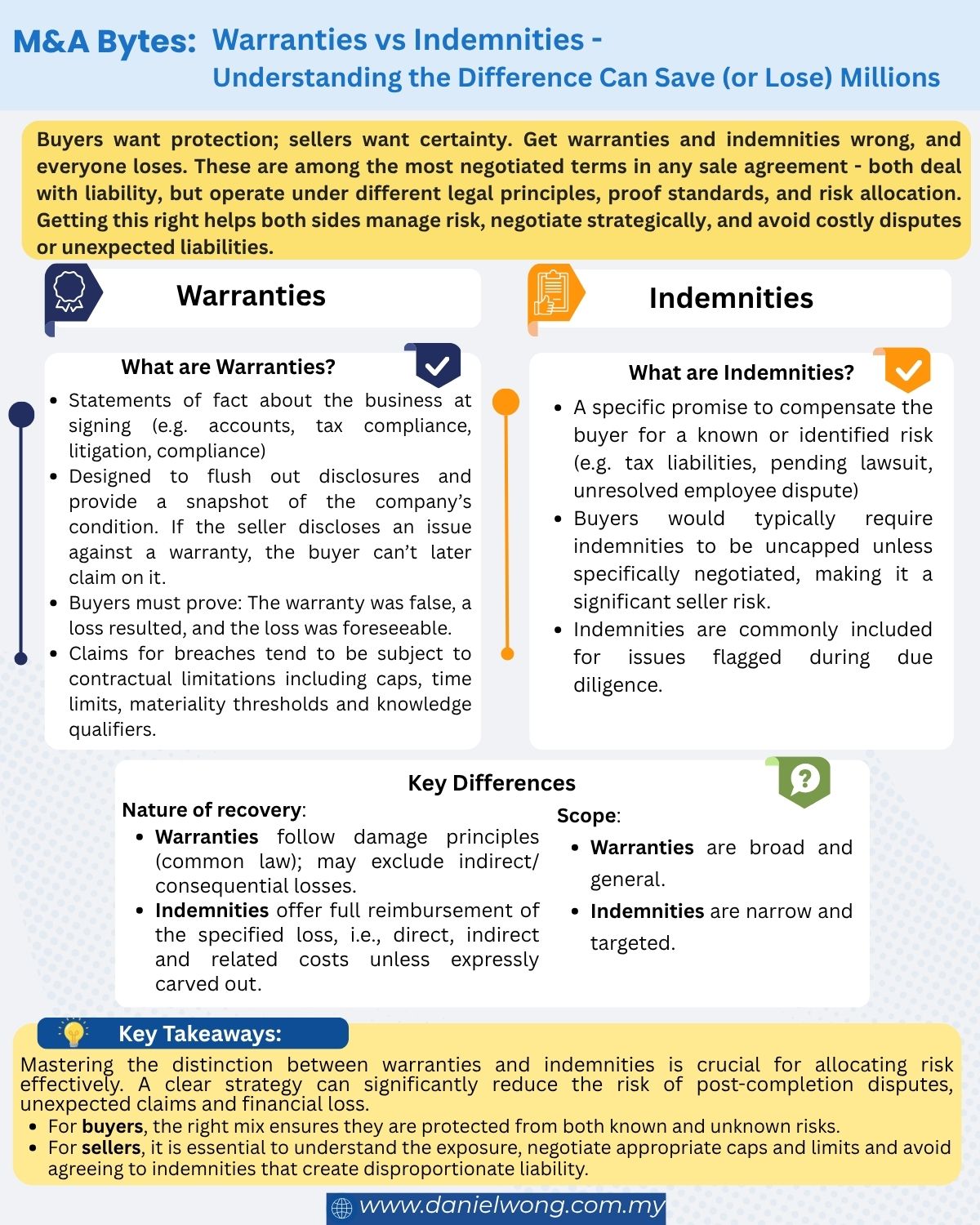
Buyers want protection; sellers want certainty – get warranties and indemnities wrong, and everyone loses.
Warranties and indemnities are among the most heavily negotiated parts of any sale and purchase agreement. While both deal with liability, they operate under different legal principles, require different levels of proof and shift risk in different ways. Understanding how warranties and indemnities work helps buyers and sellers:
- Manage and allocate transaction risk
- Negotiate protection more strategically
- Avoid costly post-completion disputes or unexpected liabilities.
What are Warranties?
- Warranties are statements of fact about the business and its condition at signing (e.g. accuracy of accounts, tax compliance, no litigation, no financing arrangements, compliance with laws)
- Warranties are designed to flush out disclosures and provide a snapshot of the company’s condition. If the seller discloses an issue against a warranty, the buyer cannot later claim for it because they accepted the risk.
- Breaches of warranties require the buyer to prove:
- the warranty was false;
- the buyer suffered a loss; and
- the loss was foreseeable.
- Claims for breaches tend to be subject to contractual limitations including caps, time limits, materiality thresholds and knowledge qualifiers.
What are Indemnities?
- Indemnities are a specific promise to compensate the buyer for a known or identified risk (e.g. tax liabilities, pending lawsuit, unresolved employee dispute)
- The buyer would typically require indemnities to be uncapped unless specifically negotiated, making indemnities a significant seller risk.
- Indemnities are commonly included for issues uncovered during due diligence.
What are the Key Differences?
- Nature of Recovery:
- Warranties – follow damage principles, which are based on common law principles and may exclude indirect or consequential losses.
- Indemnities – offer full reimbursement for the specified loss, namely direct, indirect and related costs, unless expressly carved out.
- Scope:
- Warranties – broad and general
- Indemnities – narrow and targeted
🔑 Key Takeaway:
Mastering the distinction between warranties and indemnities is crucial for allocating risk effectively.
For buyers, the right mix ensures they are protected from both known and unknown risks.
For sellers, it is essential to understand the exposure, negotiate appropriate caps and limits and avoid agreeing to indemnities that create disproportionate liability.
A clear strategy on warranties and indemnities can significantly reduce the risk of post-completion disputes, unexpected claims and financial loss.
In Essence:
Disclaimer: The content of this article is intended for general informational purposes only and does not constitute formal legal advice.
Our Corporate team regularly advises local and international corporations on mergers and acquisitions (M&A), cross-border transactions, joint ventures, and corporate restructuring. We also provide comprehensive support for shareholders’ agreements and general commercial advisory to help businesses navigate the Malaysian regulatory landscape.
For legal assistance or further inquiries regarding your corporate matters, please feel free to contact us.
