
The Power to Issue Shares: Proper-purpose or Shareholder Oppression?
A company’s decision to issue new shares may have significant consequences for its existing shareholders.
While directors are generally empowered to issue shares, that power must be exercised for a proper purpose and in the company’s interests. It cannot be used for a collateral purpose, including as a means of diluting an existing shareholder’s interest.
Following our previous discussion on shareholders’ pre-emptive rights[1], this article examines the corresponding duties imposed on directors when exercising their powers to issue new shares. In particular, we consider:
- how the Courts determine whether a share issuance was undertaken for a proper purpose;
- when an improper share issuance may also constitute shareholder oppression under Section 346 (“s.346”) of the Companies Act 2016 (“CA 2016”);
- the interplay between the proper purpose assessment and pre-emptive rights under Section 85 (“s.85”) of the CA 2016 in relation to share issuances; and
- the remedies available to aggrieved shareholders.
The ‘Proper-Purpose’ Assessment: When Is a Share Issue Valid?
(1) Directors’ Powers and the Proper-Purpose Assessment
Generally, the Courts will not ordinarily interfere with the directors’ exercise of their commercial discretion in managing the company’s affairs. This includes directors proposing a rights issue as a means of raising working capital for the company, subject to the applicable statutory and corporate requirements. This is popularly known as the ‘business judgment’ rule.[2]
However, that discretion is not unfettered.
Where the validity of a share issuance is impugned, the Court will assess whether the issuance was carried out for a ‘proper purpose’ in the company’s interests or for a collateral purpose[3].
In Howard Smith v Ampol Petroleum (“Howard Smith”)[4], the Privy Council established, amongst others, that where an exercise of the power to issue shares is challenged, the Court must “examine the substantial purpose for which it was exercised”.
The critical question is whether the share issuance was genuinely undertaken for a legitimate corporate purpose, or whether its substantial purpose was for a collateral purpose, including the dilution of an existing shareholder’s interest.
In determining whether a share issuance was undertaken for a proper purpose, the Malaysian Courts generally examine the surrounding circumstances, including the directors’ stated justifications and the contemporaneous evidence supporting the issuance.
(2) Judicial Treatment of the Proper-Purpose Assessment
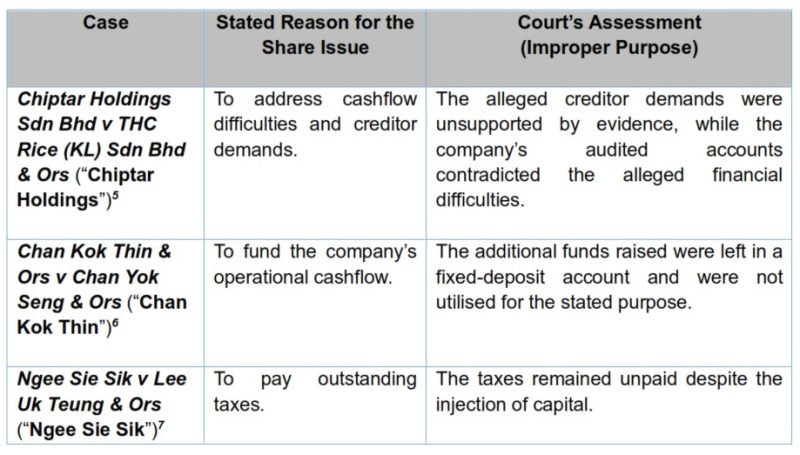
We have briefly set out the following Malaysian cases in which the Courts assessed the purpose of the share issuance to determine whether it was for a proper purpose or otherwise.
(a) Cases Where the Issuance was Held to Be for an Improper Purpose
(b) Cases Where the Issuance was Held to Be for a Proper Purpose
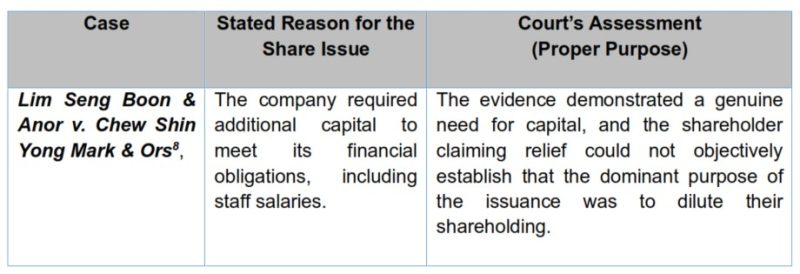
These decisions illustrate that the Courts will look beyond the directors’ stated justification for issuing new shares.
Ex facie, the mere fact that a share issuance may result in the dilution of an existing shareholder’s interest does not, by itself, render the issuance improper.
The company’s financial records, actual utilisation of the funds raised, contemporaneous documents and conduct of the parties may all be relevant in determining whether the issuance was undertaken for a proper purpose.
When Does Issuance of Shares Give Rise to Oppression?
An improper share issue may also give rise to a claim for shareholder oppression under s.346 CA 2016. However, the Court must consider whether the conduct, viewed in its entirety, satisfies the statutory requirements for relief under s.346 CA 2016.
In Chiptar Holdings, the manner in which the rights issue was undertaken was central to the Court’s finding of oppression.[9]
The Court found that one of the share issuances, which diluted specified shareholders’ shareholding from 80.93% to 19.19%, was conducted surreptitiously without actual notice to them. The directors further concealed the said issuance during a board meeting and subsequently sought to establish that notice had been given based on technicalities.[10]
Further, in Chan Kok Thin[11], the Court found oppression given that substantial shareholding was diluted (from 49.99% to 16.67%) through successive share issuances within a relatively short period. The Court also highlighted the “dubious and crafty” manner of the issuances, ostensibly to fund operational cashflow, when the proceeds were instead placed in fixed deposits.
These decisions demonstrate that beyond the extent of dilution, the Courts are also concerned with the purpose, circumstances and manner in which the share issuance was undertaken.
Interplay between the “Proper-Purpose” Assessment and Pre-Emptive Rights
As discussed in our previous article, s.85 CA 2016 protects existing shareholders against dilution by requiring new shares to be first offered to the existing shareholders, subject to the company’s constitution.
However, does compliance with s.85 CA 2016 necessarily mean that a share issuance was undertaken for a proper purpose? Ex facie, the answer is no.
Although compliance with s.85 CA 2016 was not expressly determined in Ngee Sie Sik[12], the shares were offered to the existing shareholders. Nevertheless, the Court found the issuance to be improper as the stated justification of raising funds to pay outstanding taxes was untenable, given that the taxes remained unpaid despite the injection of capital.
The case therefore illustrates that compliance with pre-emptive rights does not, in itself, establish that a share issuance was undertaken for a proper purpose. The Court would still assess whether the share issuance was undertaken for a proper purpose, despite compliance with the applicable pre-emptive rights requirements.
What Remedies Are Available?
The remedies available to an aggrieved shareholder depend on the circumstances of the case, including the nature of the conduct and the relief sought.
Where a share issuance is found to have been made for an improper purpose, the shareholder may, amongst others, challenge its validity and seek to have it set aside[13], together with consequential relief such as rectification of the register of members, where appropriate[14].
Where oppression is established under s.346 CA 2016[15], the Court has broader remedial powers. These include, amongst others, regulating the company’s affairs or ordering a buy-out of shares by other members or by the company itself[4]. In Chiptar Holdings, the Court also ordered the release of securities provided by the exiting shareholder.[16]
The power to issue new shares is an important means of raising capital, but it must not be used as a tool to manipulate shareholder control.
As the cases discussed above demonstrate, the Courts will look beyond the directors’ stated rationale to examine the true purpose and circumstances of the issuance. Directors must therefore ensure that share issuances serve a genuine commercial purpose, while shareholders should understand the grounds for challenging an improper or oppressive issuance.
Key Takeaways
When considering or challenging a share issuance, the following factors are relevant:-
Commercial rationale and purpose: Whether the issuance is supported by a genuine funding need and undertaken in the company’s interests, rather than for the collateral purpose of altering shareholder control.
Consistency of evidence: Whether the financial records, board minutes and the use of funds, viewed as a whole, are consistent with the circumstances and purpose of the share issuance.
Appropriate remedies: Whether the circumstances support a challenge to the validity of the share issuance, or even a step further to an oppression claim under s.346 CA 2016, or both.
[1] https://danielwong.com.my/pre-emptive-rights-a-shield-against-dilution-but-not-an-absolute-one/
[2] Chiptar Holdings Sdn Bhd v THC Rice (KL) Sdn Bhd & Ors [2023] 10 MLJ 932, paras 1 & 15
[3] Chiptar Holdings (n 2), para. 58 – 59
[4] [1974] A.C. 821, pg 835 – 836
[5] Chiptar Holdings (n 2), para 118 – 120
[6] [2025] MLRHU 2642, paras 42 – 60
[7] [2025] MLJU 520, paras 31 – 43, in particular para 41
[8] [2022] MLJU 1514, paras 43 – 44
[9] Chiptar Holdings (n 2), para 124
[10] Chiptar Holdings (n 2), paras 92, 96 – 97 & 121 – 125
[11] Chan Kok Thin (n 6), paras 44, 61 – 65
[12] Ngee Sie Sik (n 7)
[13] Howard Smith (n 4), pg 823 & 838
[14] Cheah Ngun Ying v Low Cheong & Sons Sdn Bhd & Ors [2010] 18 MLRH 466, pg. 470 & 479
[15] s.346(2) (a) – (e) CA 2016
[16] Chiptar Holdings (n 2), paras 171-175
[17] Ibid., para 185

This article is prepared by Thevan Aruljothi (Senior Associate).
Thevan Aruljothi is an Associate at Daniel & Wong, where he is part of the firm’s Dispute Resolution department. He specialises in corporate and commercial litigation, with a principal focus on shareholder and corporate disputes, fraud and asset recovery, contractual disputes, insolvency and winding up matters.
Our Dispute Resolution practice specialises in high-stakes civil, commercial and corporate disputes, including shareholders’ disputes, breach of contract, and debt recovery. We have experience representing clients at all levels of the Malaysian Courts, providing strategic and commercially sensible solutions to complex legal challenges.
If you require advice or representation in a legal dispute, please reach out to our team via our contact page.
Disclaimer: The content of this article is intended for general informational purposes only and does not constitute formal legal advice.
If you found this article useful, please feel free to download the PDF document in the link here.
