
Dispute Resolution
- October 16, 2026
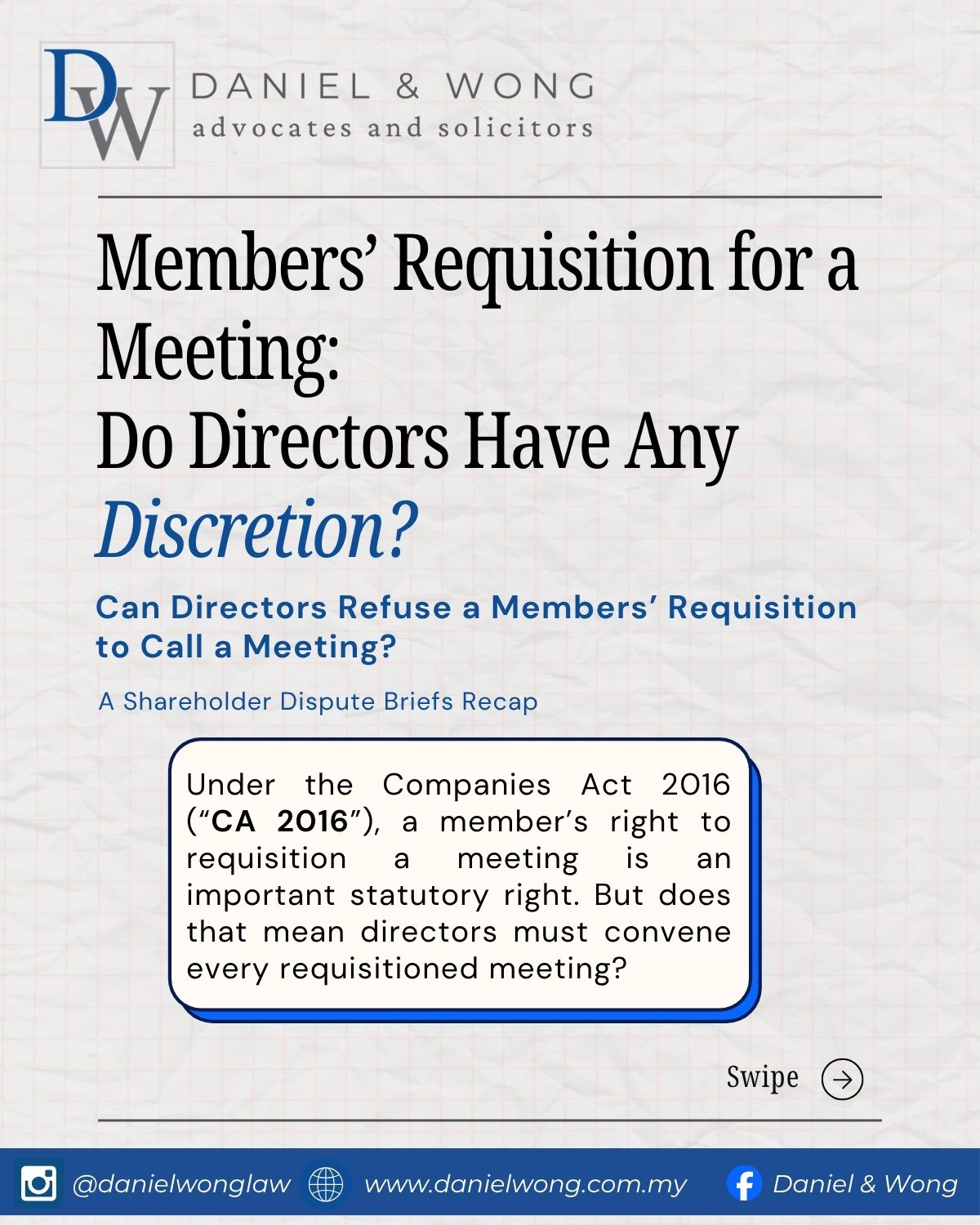
Members’ Requisition for a Meeting: Do Directors Have Any Discretion?
Can directors refuse to convene a members’ meeting requisitioned by shareholders?
Under s.311 of the Companies Act 2016, members satisfying the threshold are entitled to require directors to convene a meeting. However, does this obligation extend to resolutions that may be unlawful, ineffective or otherwise fall within the statutory exceptions in s.311(5)?
In this recap of our article originally published in July and authored by Nicholas Yap, we revisit the statutory framework, guidance from other Commonwealth jurisdictions and key considerations for shareholders and directors.
Swipe through below for a snapshot of the issues and practical takeaways.
If you missed the full article, please read it here: Shareholder Dispute Briefs | Directors’ Refusal to Convene a General Meeting Pursuant to a Members’ Requisition.
Our Dispute Resolution practice specialises in high-stakes civil, commercial and corporate disputes, including shareholders’ disputes, breach of contract, and debt recovery. We have experience representing clients at all levels of the Malaysian Courts, providing strategic and commercially sensible solutions to complex legal challenges.
If you require advice or representation in a legal dispute, please reach out to our team via our contact page.
Disclaimer: The content of this post is intended for general informational purposes only and does not constitute formal legal advice.
- September 28, 2026
Overview
Where a director misappropriates a company’s funds, and those funds are used to acquire an asset which subsequently increases in value, is the company’s recovery confined to the amount originally misappropriated?
In Eramas Konsortium Sdn Bhd v GA Yee Furniture Sdn Bhd[1], the Court of Appeal (“CA”) considered this question in the context of a breach of fiduciary duty, where RM 4.03 million of the company’s misappropriated funds was applied towards the acquisition of a parcel of land which was subsequently sold for RM 25 million.[2]
The CA affirmed that, where misappropriated funds are used to acquire an asset, a plaintiff’s proprietary interest may be traced into that substitute asset, enabling the plaintiff to assert a proportionate beneficial interest in the substitute asset, including any subsequent increase in value[3], rather than being confined to recovery of the original sum.
The decision therefore illustrates the operation of equitable tracing where misappropriated funds have been converted into a substitute asset, in circumstances involving a breach of fiduciary duty and the imposition of a constructive trust over the misappropriated funds and property.
Brief Background Facts
The Respondent, Ga Yee Furniture Sdn Bhd (“Ga Yee”), was controlled by two shareholder-directors (collectively, the “Directors”), who also controlled Encony Development Sdn Bhd (“Encony”) and Eramas Konsortium Sdn Bhd (“Eramas”).
According to the findings of the High Court (“HC”), the Directors orchestrated transfers totalling approximately RM 9.4 million from Ga Yee to Encony and Eramas, which were characterised as purported loans. The money trail was briefly as follows:-

Following the discovery of the transactions, the Directors resigned and transferred their interest in the relevant companies to third parties. Ga Yee then commenced proceedings seeking, amongst others, recovery of the misappropriated funds, declaration of constructive trust and tracing relief.
The HC found in favour of Ga Yee, holding, amongst others, that the transfers were fraudulent and that Ga Yee was entitled to trace the misappropriated funds into the Property.
Court of Appeal Decision: Spotlight
For purposes of this case digest, we focus on some of the CA’s key findings concerning the transfers and the circumstances leading to the tracing of the funds.
(1) Nature of Transactions – Were They Legitimate?
In rejecting the contention that the transfers were “related-party transactions”, the CA held that Ga Yee, Encony and Eramas were not “related companies” within the meaning of the Companies Act 2016 (“CA 2016”)[4]. Ga Yee, Encony and Eramas were separate legal entities, and the mere fact that the Directors held positions in these companies did not bring them within the statutory definition. Therefore, it did not legitimise the transfers of monies between them[5].
The CA further observed that inter-company loans between companies with common directors are not inherently prohibited under CA 2016, but necessarily attract closer scrutiny given the inherent risk of conflicts of interest and the potential misuse of corporate funds.[6]
The CA affirmed the HC’s finding that the purported “loans” were fraudulent in nature, noting, amongst others, the absence of the essential features of genuine commercial loans and non-compliance with the applicable requirements under the CA 2016.[7]
In affirming the HC’s findings that the Directors had breached their fiduciary duties to, and conspired against Ga Yee, the CA considered the cumulative effect of various circumstances, including their role in authorising and directing the transfers, the purported resolutions approving the transfers, inconsistencies in the audited accounts and their subsequent conduct.[8]
(2) The Money Trail – What Did the Money Become?
The HC found that the transfers were sham transactions disguised as loans and ordered, amongst others, that Eramas pay Ga Yee RM 11,178,313.90 (“RM 11.18m”) pursuant to the tracing process.
Eramas argued that its liability should only be limited to the RM 4,034,917.70 (“RM 4.03m”) that it had originally received from Ga Yee. The CA rejected this approach and affirmed the HC’s reliance on Foskett v McKeown[9] as a leading authority on the equitable principles of tracing, reiterating that:-
…where misappropriated funds were used to acquire a new asset, the claimant’s proprietary interest was not extinguished but may be traced into that substitute asset. The claimant may then elect to assert a proportionate beneficial interest in the asset, including any increase in its value, or alternatively claim an equitable lien to secure repayment of the original amount misapplied.[10]
Importantly, the CA clarified that the tracing exercise does not depend on establishing unconscionability or unjust enrichment. Rather, the pertinent inquiry is whether a proprietary connection between the claimant’s property and the substitute asset can be established.[11]
On the facts, the RM 4.03m transferred from Ga Yee funded approximately 39.1% of the purchase price of the Property. The CA held that Ga Yee’s proprietary right followed that money into the Property and subsequently into the RM 25 million sale proceeds. Ga Yee was therefore entitled to 39.1% of the sale proceeds, amounting to RM 9.775 million. A visualisation of the tracing process is as follows:
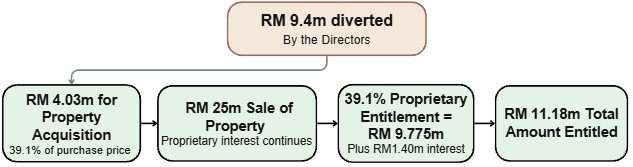
The CA emphasised that this was not treated as a mere “repayment” of the RM 4.03m, but as Ga Yee’s proprietary entitlement to what the RM 4.03m had become.[12]
The CA also distinguished between the proprietary remedy arising from tracing and the personal remedies arising from the breaches of fiduciary duty and conspiracy.[13]
(3) Constructive Trust – Does It Need to be Pleaded?
Notably, in rejecting Eramas’ contention that Ga Yee had failed to plead a sufficient basis for constructive trust relief, the CA held that a constructive trust is not an independent cause of action but an equitable remedy which may be granted where the facts pleaded justify such intervention.
The relevant question was therefore not whether “constructive trust” was specifically pleaded, but whether the material facts establishing a basis for such relief had been pleaded and proved. The CA found that Ga Yee had satisfied this requirement[14].
Conclusion
Eramas Konsortium illustrates the operation of equitable tracing in the context of misappropriated corporate funds following a breach of fiduciary duty. Its significance lies not simply in recovering the monies originally misappropriated, but in determining whether the plaintiff’s proprietary interest can be traced into what those monies became, including the resulting asset and, where applicable, its eventual sale proceeds.
Key Takeaways
Trace the money, not just the loss
Where misappropriated funds are used to acquire an identifiable asset, the plaintiff should consider whether its proprietary interest can be traced into the substitute asset and, where appropriate, its eventual sale proceeds, including any increase in value.
Common directorships warrant closer scrutiny
Inter-company loans between companies are not, in themselves, prohibited, but warrant closer scrutiny given the inherent risks of conflicts of interest and potential misuse of corporate funds.
Constructive trust is an equitable remedy
A constructive trust is not an independent cause of action. The focus is on pleading and proving the material facts supporting the relief.
[1] Civil Appeals No. P-02(NCvC)(W)-1792-10/2024 & P-02(NCvC)(W)-1991-11/2024
[2] ibid, para [62]
[3] ibid, para [67] – [73]
[4] Section 7 of the Companies Act 2016
[5] Eramas Konsortium (n 1), para [21] – [26]
[6] ibid, para [27]
[7] ibid, para [28] – [34]
[8] ibid, para [39] – [48]
[9] [2000] UKHL 29. See also Takako Sakao v Ng Pek Yuen & Anor [2009] 6 MLJ 751 and;
Tay Choo Foo @ Tay Chiew Foo v Tengku Mohd Saad @ Tengku Arifaad bin Tengku Mansur [2008] MYCA 88
[10] Eramas Konsortium (n 1), para [68]
[11] ibid, para [69]
[12] ibid, para [71]
[13] ibid, para [72] – [74]
[14] Eramas Konsortium (n 1), para [55] – [58]


This article is prepared by Natalie Lim (Associate) and Amanda Yap (Associate).
Natalie Lim Tze Thong is an Associate at Daniel & Wong, specialising in corporate and commercial litigation within the firm’s dispute resolution practice group.
Amanda Given is an Associate at Daniel & Wong, where she is a part of the firm’s Dispute Resolution department, specialising in civil, corporate and commercial litigation.
Our Dispute Resolution practice specialises in high-stakes civil, commercial and corporate disputes, including shareholders’ disputes, breach of contract, and debt recovery. We have experience representing clients at all levels of the Malaysian Courts, providing strategic and commercially sensible solutions to complex legal challenges.
If you require advice or representation in a legal dispute, please reach out to our team via our contact page.
Disclaimer: The content of this article is intended for general informational purposes only and does not constitute formal legal advice. Kindly refer to the complete decision and reasoning in Eramas Konsortium Sdn Bhd v Ga Yee Furniture Sdn Bhd (Civil Appeals No. P-02(NCvC)(W)-1792-10/2024 & P-02(NCvC)(W)-1991-11/2024).
If you found this article useful, please feel free to download the PDF document in the link here.
- September 21, 2026
Daniel & Wong is pleased to announce the promotion of Nicholas Yap to Partner and Thevan Aruljothi to Senior Associate, effective 1 September 2026.
Nicholas and Thevan have been valued members of our Dispute Resolution team, contributing to complex and high-value civil, corporate, and commercial disputes.
These promotions recognise their hard work, dedication and continued contributions to the Firm, and mark exciting new chapters in their careers with us.
Please join us in congratulating Nicholas and Thevan on these significant milestones and wishing them continued success in their new roles.
- August 27, 2026
Pre-emptive rights give existing shareholders the first opportunity to subscribe for new shares, allowing them to maintain their proportionate shareholding and protect themselves against dilution.
In Malaysia, such rights are principally provided for under Section 85 (“S.85”) of the Companies Act 2016 (“CA 2016”).
However, this protection is not absolute. S.85 CA 2016 is expressly subject to a company’s constitution, and its operation must be considered alongside other relevant statutory provisions, such as Section 75 (“S.75”) CA 2016.
This article therefore considers:-
- the extent of protection afforded by 85;
- the circumstances in which pre-emptive rights may be disapplied or waived;
- the interaction between 75 and S.85; and
- the consequences of a breach of pre-emptive rights.
What Does S.85 CA 2016 Actually Protect?
S.85(1) CA 2016 provides that:
“Subject to the constitution, where a company issues shares which rank equally to existing shares as to voting or distribution rights, those shares shall first be offered to the holders of existing shares in a manner which would, if the offer were accepted, maintain the relative voting and distribution rights of those shareholders.” (emphasis added)
At first glance, the provision appears straightforward: where a company issues qualifying new shares, the existing shareholders should first be given the opportunity to subscribe to preserve their relative voting and distribution rights in the company.
However, there is an important qualification in the opening words of S.85 – “subject to the constitution”. Ex facie, this suggests that the shareholders may, through the company’s constitution, determine the extent to which their pre-emptive rights apply.
This was recognised by the Federal Court (“FC”) in Dato’ Azizan bin Abd Rahman & Ors v Concrete Parade Sdn Bhd & Ors and other appeals[1] (“Dato’ Azizan”), where the FC held that the pre-emptive rights afforded by S.85(1) are:-
“dependent on how the shareholders, as investors, have contracted in their AA (or constitution), firstly with the company and secondly with other shareholders or members inter se”.[2]
Accordingly, where a company has a constitution, the constitution should be the starting point in determining whether and to what extent pre-emptive rights apply. The constitution may fortify such rights, modify their operation, or provide for their disapplication[3]. Where there is no constitution, S.85 provides the statutory framework governing those rights.
How Are Pre-Emptive Rights Displaced or Waived?
At its core, a pre-emptive right is a right of priority or first preference. It does not confer an interest in the shares themselves; rather, it gives shareholders a right of first choice. Such a right may be waived even if it arises from statute[4].
The more difficult question is: what is sufficient to establish a valid disapplication or waiver of pre-emptive rights?
(1) Shareholders’ Approval
Where a company’s constitution expressly provides that the pre-emptive right is subject to the direction of the company at general meeting, can shareholders’ approval of a transaction itself constitute such a direction, thereby disapplying those pre-emptive rights?
This was considered by the FC in Dato’ Azizan. There, the constitution provided that the pre-emptive right was “subject to direction to the contrary by the company at general meeting”. The FC held that the shareholders’ approval of the proposed business merger / private placement constituted, in the circumstances, such a “direction”, with the effect of disapplying their pre-emptive rights.[5]
Notably, the circular seeking shareholders’ approval did not expressly refer to S.85 or state that approval of the transaction would amount to disapplication of their pre-emptive rights. Nevertheless, the FC considered that in approving the transaction, the shareholders did, or ought to have, comprehended its dilutive effects and that they were thereby disapplying their pre-emptive rights[6].
Thus, what matters is whether the shareholders’ approval objectively demonstrates an informed acceptance of the proposed transaction and its consequences.
Shareholders’ approval, however, is not a blanket cure for non-compliance with S.85 CA 2016. The manner in which shareholders’ approval is obtained remains crucial.
In TAS Capital Sdn Bhd v Muhammed Shareef Mohamed Sagubar & Ors[7], the shareholder complained that an issuance of shares had diluted its majority shareholding.
Although an EGM had been convened, the High Court found, amongst others, that it had not been properly convened and that the shareholder had not been given prior notice. The Court consequently found a breach of S.85 and held that both the EGM and the share allotment were void[8].
The distinction, therefore, lies between valid and informed shareholder approval obtained at a duly convened meeting, and an irregularly convened meeting which, in itself, cannot defeat a shareholder’s pre-emptive rights.
(2) Contractual Waiver
Pre-emptive rights may also be waived by contract.
In Pan Choon Weng v Mexvin Chow Yew Hoong & Ors (“Pan Choon Weng”),[9] the High Court held that the shareholder had waived his pre-emptive rights (and the operation of S.85) and agreed to allow the directors to issue shares for the specified purposes, particularly by agreeing to Clause 3 of the shareholders’ agreement, which expressly waived the right of first offer of shares[10].
Pertinently, the Court observed that a statutory right such as the pre-emptive right may generally be contracted out of, subject to applicable public policy considerations.[11]
(3) Conduct & Acquiescence
A waiver of pre-emptive rights may also arise through a shareholder’s conduct.
In Kyowa Kanko Kaihatsu Co Ltd v Vasseti Berhad, the Court found that a waiver of the shareholder’s pre-emption rights could be inferred from the various correspondence and communications objectively demonstrating that the shareholder did not intend, or was unable, to subscribe for the new shares.[12]
In Pioneer Motor Service Company Sdn Bhd v Chin Cheng Hong Sdn Bhd, the Court of Appeal rejected an argument that the shareholder’s past conduct or a purported “common practice” of disregarding pre-emptive rights was sufficient to establish a waiver binding on the shareholder in respect of subsequent breaches.[13]
These cases therefore suggest that waiver may be inferred from conduct in appropriate circumstances, but cannot simply be presumed from past conduct, acquiescence or “common practice”. The shareholder’s conduct must objectively demonstrate an intention to relinquish the relevant rights.
Interaction Between S.75 and S.85 CA 2016
Briefly, S.75 CA 2016 requires shareholders’ approval before directors may exercise certain powers to allot shares. S.75(2) provides the exceptions to this general rule.
In Pan Choon Weng, the defendants argued that S.75 and S.85 should be construed such that, where an allotment falls within an exception under S.75(2), the shares need not first be offered to existing shareholders under S.85[14].
The High Court ultimately dismissed the plaintiff’s claim. In this regard, the High Court held that the two provisions should be construed so as to “complement” each other and applied according to the circumstances of each case; otherwise, the statutory exception under S.75(2)(c) would be deprived of its efficacy[15].
However, this position must be considered alongside the subsequent FC decision of Dato’ Azizan. While the FC also emphasised that S.75 and S.85 should be read harmoniously, it expressly observed that S.85(1) is “not subject to s.75”[16].
The extent to which an exception under S.75(2) affects the operation of S.85 therefore warrants careful consideration.
What Happens When Pre-Emptive Rights Are Breached?
When a company proceeds with issuance of shares without complying with applicable pre-emptive rights, the affected shareholder may have various remedies depending on the circumstances, including declaratory relief[17], rectification of the register of members[18], oppression relief[19] or other appropriate orders.
However, a breach of pre-emptive rights does not necessarily mean that the resulting allotment is incapable of being cured. The Court may, in appropriate cases where it is just and equitable to do so and where no substantial injustice would result, exercise its statutory powers to validate or regularise any issuance or allotment of shares that would otherwise be irregular[20].
Key Takeaways
S.85 protects shareholders against dilution, but this protection is not absolute. It is subject to the company’s constitution and must be read together with other relevant statutory provisions, particularly S.75 CA 2016.
Pre-emptive rights may be disapplied or waived. This may arise through the constitution, shareholders’ approval, contractual arrangements or, in appropriate circumstances, inferred from conduct.
The manner in which rights are disapplied or waived matters. An intention to preserve, waive or disapply pre-emptive rights should be clearly documented; past acquiescence alone may not suffice.
[4] LGB Engineering Sdn Bhd & Ors v Rayston Resources Sdn Bhd [2022] MLRAU 196, para 82-83.
[5] Dato’ Azizan (n 1), para 174-176.
[6] ibid, para 171-187.
[7] [2026] MLRHU 2410.
[8] ibid, para 80-87.
[9] [2023] 10 MLJ 544.
[10] ibid, para 83 & 90-91.
[11] ibid, para 85-89.
[12] [2019] CLJU 2392, para 133-135.
[13] [2003] 1 MLRA 264, pg 267.
[14] Pan Choon Weng (n 9), para 49.
[15] ibid, para 80-81.
[16] Dato’ Azizan (n 1), para 128 & 134.
[17] TAS Capital (n 7), where the Plaintiff successfully sought inter alia a declaration that the issuance of shares was void and illegal.
[18] Pioneer Motor (n 13), where the Respondent sought inter alia rectification of the register of members under S.162 of the Companies Act 1965 to remove a third-party company as the holder of shares.
[19] Chiptar Holdings Sdn Bhd v THC Rice (K.L.) Sdn Bhd & Ors [2023] 1 LNS 585, where the Plaintiff successfully established a case of oppressive conduct under S.346 of the CA 2016.
[20] CA 2016, S.108. See also Kelapa Sawit (Teluk Anson) Sdn Bhd v Dr. Yeoh Kim Leng & Ors [1991] 1 CLJ (Rep) 194 at pg 204, where the Supreme Court drew a distinction between an act which does not bind the company and an act that is capable of regularisation or validation.

This article is prepared by Natalie Lim (Associate), assisted by Dhevasree (Pupil-in-Chambers).
Natalie Lim Tze Thong is an Associate at Daniel & Wong, specialising in corporate and commercial litigation within the firm’s dispute resolution practice group.
Dhevasree is currently undergoing her pupillage under the tutelage of Daniel Albert, the Partner heading the firm’s Dispute Resolution division.
Our Dispute Resolution practice specialises in high-stakes civil, commercial and corporate disputes, including shareholders’ disputes, breach of contract, and debt recovery. We have experience representing clients at all levels of the Malaysian Courts, providing strategic and commercially sensible solutions to complex legal challenges.
If you require advice or representation in a legal dispute, please reach out to our team via our contact page.
Disclaimer: The content of this article is intended for general informational purposes only and does not constitute formal legal advice.
If you found this article useful, please feel free to download the PDF document in the link here.
- August 7, 2026
Overview
Can a company place a hostile creditor into a class of its own, and seek to cram it down under a proposed scheme of arrangement (“PSOA”)?
This issue arose in KL Petrogas Sdn Bhd v SA Puncak Management Sdn Bhd [2026] MLJU 1663, one of the first substantive judicial considerations of the cross-class cram down regime introduced under S.368D of the Companies Act 2016 (“CA 2016”).
Under a conventional scheme of arrangement in S.366(3) CA 2016, each creditor class must approve the PSOA by a majority of at least 75% in value of the creditors present and voting in that class. Consequently, a creditor holding more than 25% of the debt within a creditor class may effectively block the statutory majority, giving it a practical veto over the PSOA.[1]
That position appears to have changed with S.368D CA 2016[2], introduced via the Companies (Amendment) Act 2024 (“2024 Amendment”). Subject to the statutory requirements and safeguards under S.368D being satisfied, the Court may now sanction a scheme notwithstanding the rejection by one or more creditor classes.
Briefly, in KL Petrogas, the respondent (“SA Puncak”), the largest unsecured creditor holding approximately 29% of the unsecured debt, made clear that it would oppose any scheme proposed by the applicant (“KL Petrogas”). KL Petrogas responded by placing SA Puncak into a separate creditor class, seeking to invoke the cross-class cram down mechanism under S.368D CA 2016.[3]
The High Court (“HC”) described this as an “audacious move” [4]. Nevertheless, the HC granted the convening order, finding no obvious roadblock or unfairness warranting refusal at that stage[5].
However, the HC did not determine whether SA Puncak could ultimately be crammed down under S.368D CA 2016. Questions concerning the bona fides of the class composition and the parties’ conduct were expressly left to be considered at the sanction stage[6].
This article examines key aspects of the HC’s decision:
- The operation of the 75% statutory threshold under S.366 and S.368D CA 2016;
- The fairness standard applicable to a cross-class cram down; and
- The Court’s approach to deliberate creditor class composition in facilitating a cross-class cram down.
Background
- KL Petrogas encountered financial difficulties following enforcement action by SA Puncak under financing facilities exceeding RM22 million. SA Puncak subsequently terminated the financing facilities and appointed Receivers and Managers over KL Petrogas pursuant to the debenture.[7]
- In separate proceedings (Suit 787), the High Court held that certain agreements relating to the pre-factoring facility were unenforceable and that the debenture was void to the extent it secured that facility. Accordingly, SA Puncak was treated as an unsecured creditor for KL Petrogas’s proposed restructuring. The decision remains subject to appeal.[8]
- Against this backdrop, KL Petrogas sought an order from the HC to convene meetings of its creditors for the purposes of considering and approving a scheme of arrangement.
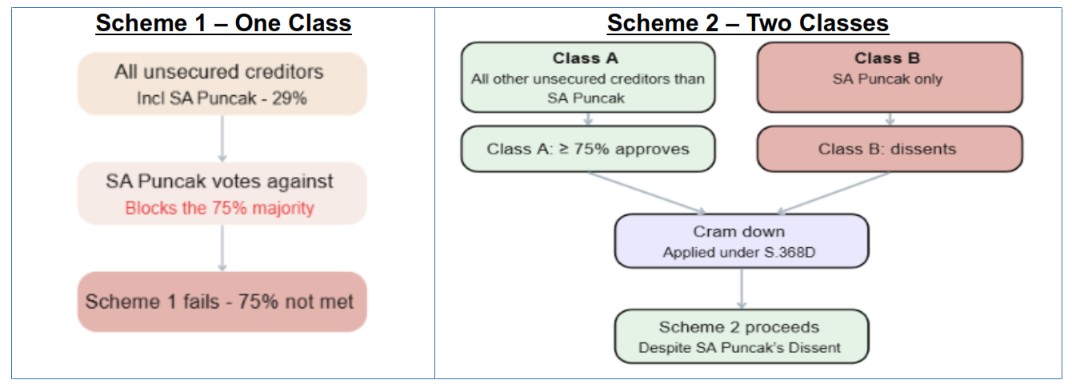
- Under the initial proposed scheme (“Scheme 1”), all unsecured creditors were placed in a single class and would be repaid on a pari passu basis.
- However, SA Puncak, holding approximately 29% of the unsecured debt, made clear that it intended to vote against Scheme 1.[9]
- To overcome this, KL Petrogas proposed a revised scheme (“Scheme 2”) by invoking the cross-class cram down regime under S.368D CA 2016, as illustrated below.
- The strategy for Scheme 2 was straightforward: if Class A achieved the requisite 75% statutory majority, KL Petrogas could seek to invoke the cram down mechanism under S.368D CA 2016 to bind Class B notwithstanding SA Puncak’s dissent. The HC described this as an “audacious move”[10].
- The question before the HC was whether the proposed cross-class structure presented an obvious “roadblock” or abuse of process such that the HC should refuse to convene the creditor meetings.
HC Decision & Key Findings
The HC granted the convening order after considering comparative jurisprudence from the UK, US and Singapore. Central to the HC’s reasoning was the legislative purpose underlying S.368D CA 2016.[11] As the HC observed:
“…the very objective and purpose of the cram down legislation, to prevent a recalcitrant creditor from vetoing a beneficial scheme that is wanted by the other creditors”[12].
The HC’s reasoning can broadly be distilled as follows: –
(1) The 75% Statutory Threshold [13]
Conventional Scheme, S.366 CA 2016
Cross-class Cram Down, S.368D CA 2016
- S.366(3) requires each creditor class to independently satisfy the statutory threshold, i.e., approval by a majority representing at least 75% in value of the creditors of that class present and voting.
- Consequently, a creditor holding more than 25% of the debt within a class could, by itself, prevent that class from achieving the statutory threshold, effectively creating a blocking position.
- S.368D appears to be the exception to the conventional scheme.
- It applies where:[14]
(a) a vote has taken place at a relevant meeting convened under S.366(1) CA 2016;
(b) creditors are placed into two or more classes;
(c) at least one class (“Assenting Class”) has approved the scheme by satisfying the 75% threshold under S.366(3); and
(d) at least one class (“Dissenting Class”) has not approved the scheme by the requisite statutory majority.
- Where the statutory requirements and safeguards under S.368D(3) and (4) are satisfied, the Court may approve the scheme under S.368D(2), notwithstanding the rejection by the Dissenting Class.
- Accordingly, the Dissenting Class’s protection shifts from an absolute voting veto to judicial oversight through the statutory safeguards under S.368D.
(2) The Applicable ‘Fairness’ Test
- Under a conventional scheme of arrangement[15], the Court generally applies the “limited rationality” test, i.e., whether an intelligent and honest creditor, acting in their own interest, could reasonably approve the scheme.
- However, the HC held that this test is not appropriate in the context of cross-class schemes[16]. Unlike a conventional scheme, a cross-class cram down necessarily involves a creditor class that has not approved the proposed scheme by the requisite statutory majority. As such, fairness cannot simply be assumed from creditor approval.
- The HC further observed that the “limited rationality” test merely serves as a “cross-check” to an affirmative vote of the creditor class and therefore has no application where the Dissenting Class has not approved the scheme.
- Instead, the HC held that the appropriate inquiry is whether the restructuring achieves a fair distribution of the benefits it generates among the affected creditor classes[17].
- Accordingly, the Court must consider (1) whether the restructuring benefits are fairly distributed among creditor classes and (2) whether the dissenting class is treated fairly and equitably.
- On the facts, the HC found no unfairness at the convening stage. Scheme 2 afforded identical treatment to both classes of unsecured creditors, with all creditors entitled to full repayment on a pari passu [18]
(3) Deliberate Class Composition is not, at the Convening Stage, an Automatic Abuse of Process (S.368 CA 2016)[19]
- SA Puncak argued that placing it into a separate class solely to facilitate a cram down amounted to a “capricious use” of S.368D CA 2016 and an abuse of process. The question before the HC was whether the proposed class composition constituted a “roadblock” or whether Scheme 2 was proposed in bad faith or otherwise amounted to an abuse of process such that the convening order should be refused.
- While recognising that such an argument may be correct under the conventional scheme framework, the HC held that the legal landscape had changed with S.368D CA 2016. At the convening stage, the HC observed that the purpose of the regime is to prevent, in appropriate cases, a dissenting creditor from exercising an unjustified veto over an otherwise beneficial restructuring.
- In this regard, the HC held that it could “see no reason why a company may not take advantage of the cram down provisions to cram down a hostile creditor with a veto right in the appropriate case.”
- Nevertheless, the HC emphasised that this did not amount to a final determination that the proposed class composition was permissible. Whether the proposed class composition was ultimately bona fide and whether Scheme 2 satisfied the statutory safeguards under S.368D CA 2016 remained fact-sensitive questions to be determined at the sanction stage[20].
Key Takeaways
S.368D CA 2016 and the 75% Statutory Threshold
Under the conventional scheme, each creditor class must independently satisfy the 75% statutory threshold under S.366(3) CA 2016, which allows a creditor holding more than 25% of a class’s debt to effectively block the scheme.
Under S.368D, however, a scheme may proceed notwithstanding the rejection of a dissenting class, provided that at least one creditor class has approved the scheme by the requisite statutory majority and the statutory safeguards are satisfied.
The ‘fairness’ standard under S.368D CA 2016 departs from the conventional “limited rationality” test.
The Court must determine whether restructuring benefits are fairly distributed among creditor classes and whether the dissenting class is treated fairly and equitably.
Deliberate class composition is not inherently impermissible at the convening stage.
A scheme company may, in an appropriate case, structure creditor classes in a manner that facilitates the operation of S.368D CA 2016. However, the fairness of such structuring, the parties’ bona fides, and any potential abuse of process remain subject to scrutiny at the sanction stage.
Conclusion
The decision provides early judicial guidance on Malaysia’s cross-class cram down regime, clarifying that the conventional “limited rationality” test does not apply in the S.368D context and that deliberate creditor class composition is not, by itself, impermissible at the convening stage. However, whether such restructuring is bona fide and whether the statutory safeguards are ultimately satisfied remain matters for determination at the sanction stage.
More broadly, the decision highlights the significance of S.368D in addressing the limitations of conventional schemes, where a single dissenting creditor holding a blocking position could prevent an otherwise viable restructuring from proceeding. By limiting such blocking power while preserving judicial oversight, the regime enables distressed companies to pursue genuine restructuring efforts consistent with the legislative objective of promoting corporate rescue.
[1] Para [6] – [11] of KL Petrogas Sdn Bhd v SA Puncak Management Sdn Bhd [2026] MLJU 1663
[2] Para [74] – [75], [121] – [126]
[3] Para [7] – [11], [67] – [71]
[4] Para [71]
[5] Para [125] – [126] & [134]
[6] Para [133]
[7] Para [12] – [23]
[8] Para [24] – [43]
[9] Para [44] – [70]
[10] Para [71] – [72]
[11] Paras [121] – [125]
[12] Para [125]
[13] Para [7] – [11]; [74] – [82]
[14] Para [77]
[15] Para [84] – [85]
[16] Para [98] & [102]
[17] Para [87], [91] – [110]
[18] Para [115] – [116] & [134]
[19] Para [117] – [126] (in particular: para [119], [123] – [125])
[20] Para [133]

This article is prepared by Thevan Aruljothi (Associate) and Amanda Yap (Associate).
Thevan Aruljothi is an Associate at Daniel & Wong, where he is part of the firm’s Dispute Resolution department. He specialises in corporate and commercial litigation, with a principal focus on shareholder and corporate disputes, fraud and asset recovery, contractual disputes, insolvency and winding up matters.
Amanda Given is an Associate at Daniel & Wong, where she is a part of the firm’s Dispute Resolution department, specialising in civil, corporate and commercial litigation.
Our Dispute Resolution practice specialises in high-stakes civil, commercial and corporate disputes, including shareholders’ disputes, breach of contract, and debt recovery. We have experience representing clients at all levels of the Malaysian Courts, providing strategic and commercially sensible solutions to complex legal challenges.
If you require advice or representation in a legal dispute, please reach out to our team via our contact page.
Disclaimer: The content of this article is intended for general informational purposes only and does not constitute formal legal advice. Please refer to the Grounds of Judgment in the Federal Court Civil Appeal No. 02(f)-9-03/2025(W).
If you found this article useful, please feel free to download the PDF document in the link here.
- July 30, 2026
In Malaysia, a member’s right to convene a meeting has been recognised as a valuable right which must remain unfettered, as it is inextricably linked to a member’s sacrosanct right to vote[1].
Generally, there are four modes in which a members’ meeting may be convened under the Companies Act 2016 (“CA 2016”): –
- by the board of directors (310(a));
- by a member (310(b));
- by the board pursuant to a requisition made by members (311 – S.313); and
- by an Order of the Court (314).
This article focuses on the third category (i.e., a members’ meeting convened by the board pursuant to a members’ requisition under S.311) and, more significantly, on whether directors possess any discretion to refuse such a requisition.
The Statutory Right of Members to Requisition a Meeting
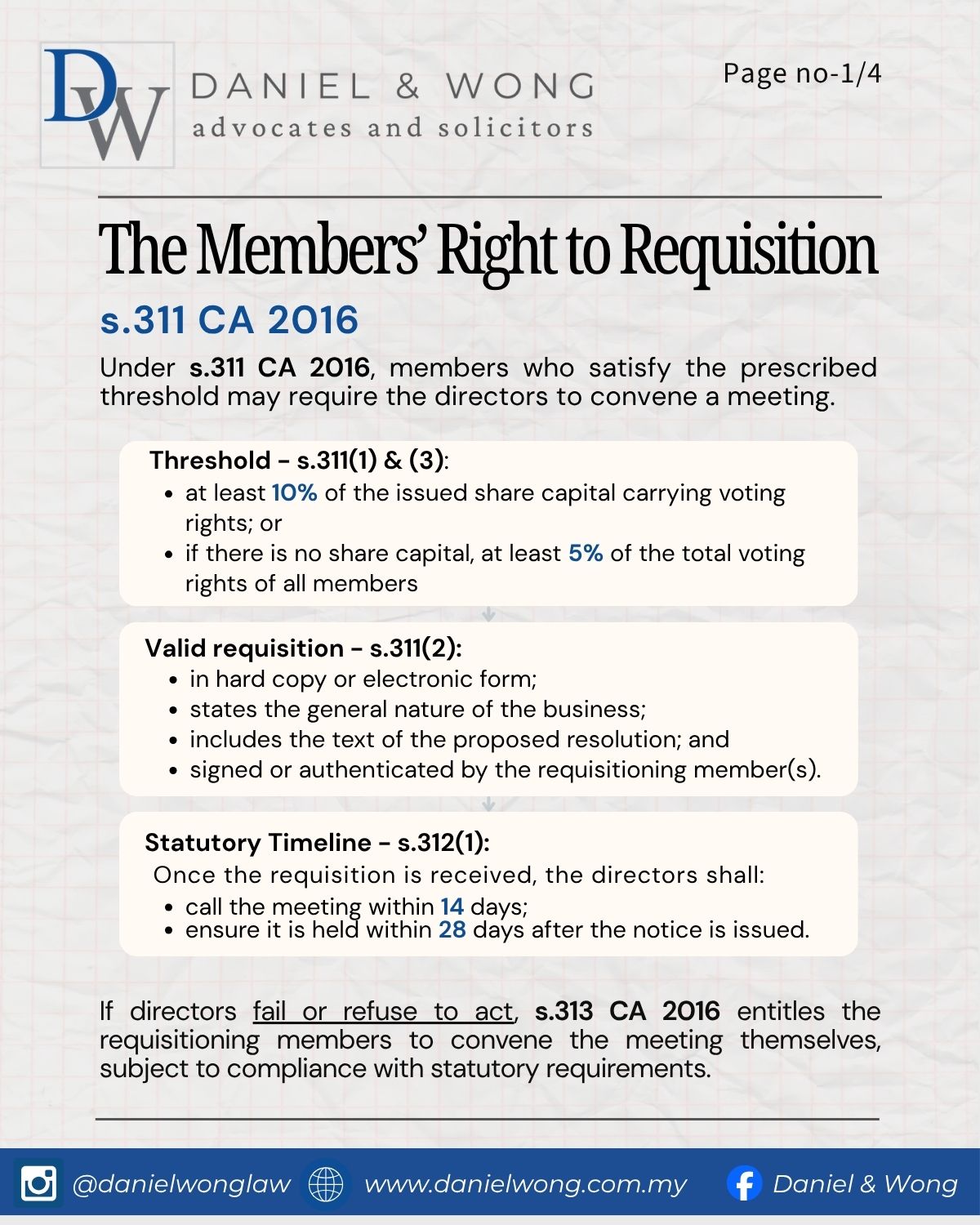
S.311(1) and (3) CA 2016 confer upon members who satisfy the prescribed statutory threshold the right to require the directors to convene a meeting of members.
The requisite threshold is: –
- at least 10% of the issued share capital carrying voting rights; or
- where the company has no share capital, at least 5% of the total voting rights of all members.
At first glance, the use of the plural word “members” in S.311 may suggest that a requisition must be made by more than one member.
However, it has been held that S.311 is equally capable of applying to a single member[2], provided that the requisite statutory threshold is satisfied.
In addition, S.311(2) CA 2016 prescribes several formal requirements for a valid requisition. The requisition must: –
- be in hard copy or electronic form;
- state the general nature of the business to be transacted;
- where appropriate, include the text of the proposed resolution; and
- be signed or otherwise authenticated by the requisitioning member(s).
Statutory Timeframe to Call the Meeting
Upon receipt of a requisition, the statutory timeframe is clear. The directors shall: –
- call the meeting within 14 days of receiving the requisition; and
- ensure that the meeting is held within 28 days after the notice convening the meeting is issued.
Where the directors fail or refuse to do so, S.313 CA 2016 entitles the requisitioning members to convene the meeting themselves, subject to compliance with the remaining statutory requirements.
Significantly, any reasonable expenses incurred by the requisitioning members are reimbursable by the company, which is in turn entitled to retain the corresponding amount from any fees or other remuneration payable to the defaulting director(s)[3].
Do the Directors Have No Discretion?
The statutory framework naturally raises an important question.
Does it mean that directors are obliged to convene every requisitioned meeting?
This is not merely a theoretical question. It was, in fact, the central issue in a shareholder dispute in which we previously acted successfully for the directors of a company. In that matter, the directors were required to determine whether they were legally obliged to convene a members’ meeting pursuant to requisitions which, amongst others, contained proposed resolutions that were prima facie unlawful.
Taken to its logical conclusion, an interpretation that the directors have no discretion whatsoever would effectively require the directors to convene meetings even where the proposed business or resolution is plainly unlawful, contrary to the company’s constitution, or incapable of being validly implemented.
Such a result would be difficult to reconcile with the directors’ broader duties to act in the best interest of the company and in accordance with its constitution.
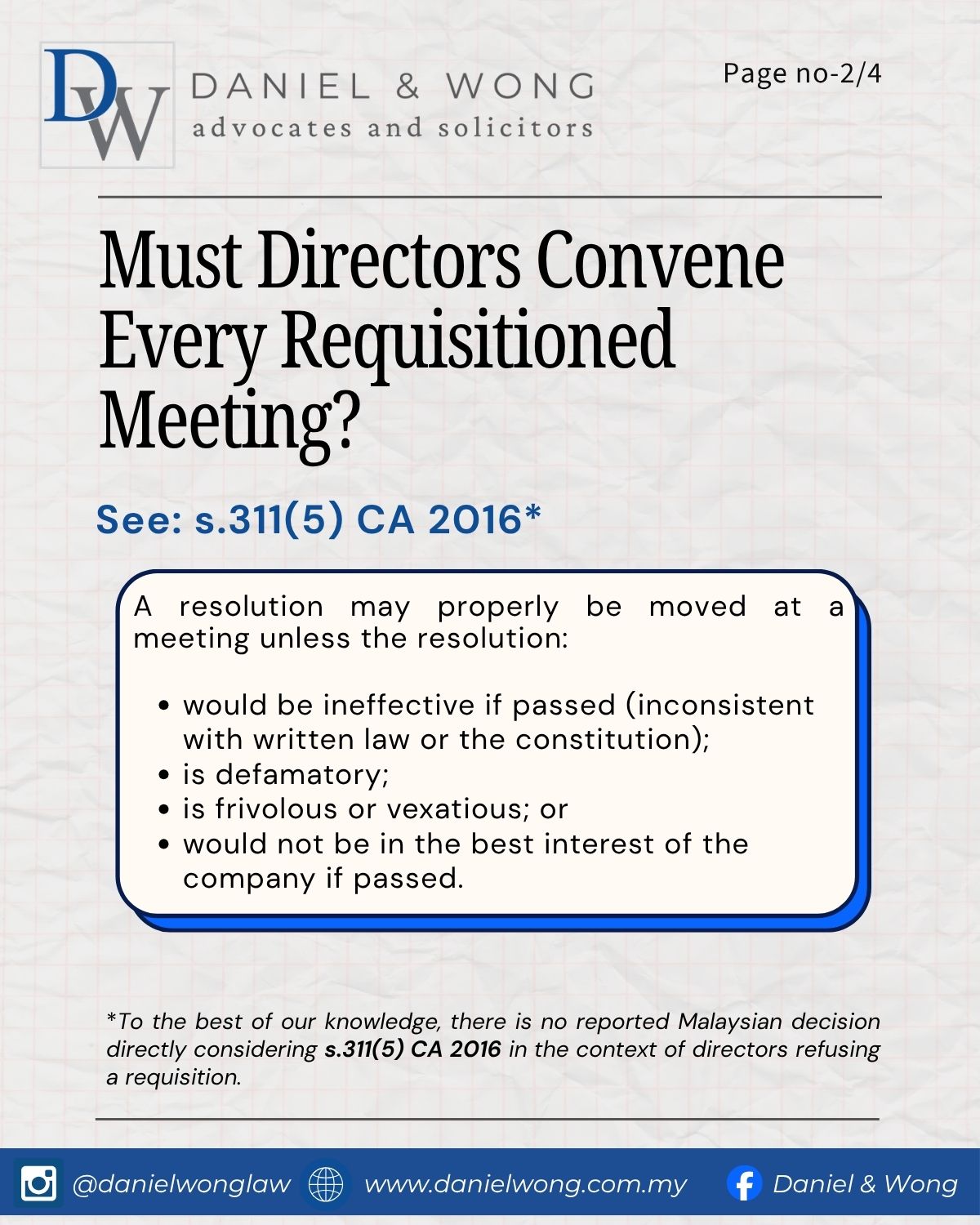
This issue must also be considered in light of S.311(5) CA 2016, a provision introduced under the CA 2016, which provides that: –
(5) A resolution may properly be moved at a meeting unless the resolution: –
(a) if passed, would be ineffective whether by reason of inconsistency with any written law or the constitution;
(b) is defamatory of any person;
(c) is frivolous or vexatious; or
(d) if passed, would not be in the best interest of the company.
Presently, to the best of our knowledge, there appears to be no reported Malaysian decision directly considering the scope or application of S.311(5) in the context of directors refusing to convene a meeting pursuant to a members’ requisition.
Guidance from Other Commonwealth Jurisdictions
In the absence of direct Malaysian authority, guidance may be drawn from other Commonwealth jurisdictions.
A. Position in the United Kingdom
In this regard, S.303(5) of the UK Companies Act 2006 is substantially similar to S.311(5) of our CA 2016.
S.303(5) of the UK Companies Act 2006 provides that:-
(5) A resolution may properly be moved at a meeting unless:-
(a) it would, if passed, be ineffective (whether by reason of inconsistency with any enactment or the company’s constitution or otherwise);
(b) it is defamatory of any person; or
(c) it is frivolous or vexatious.
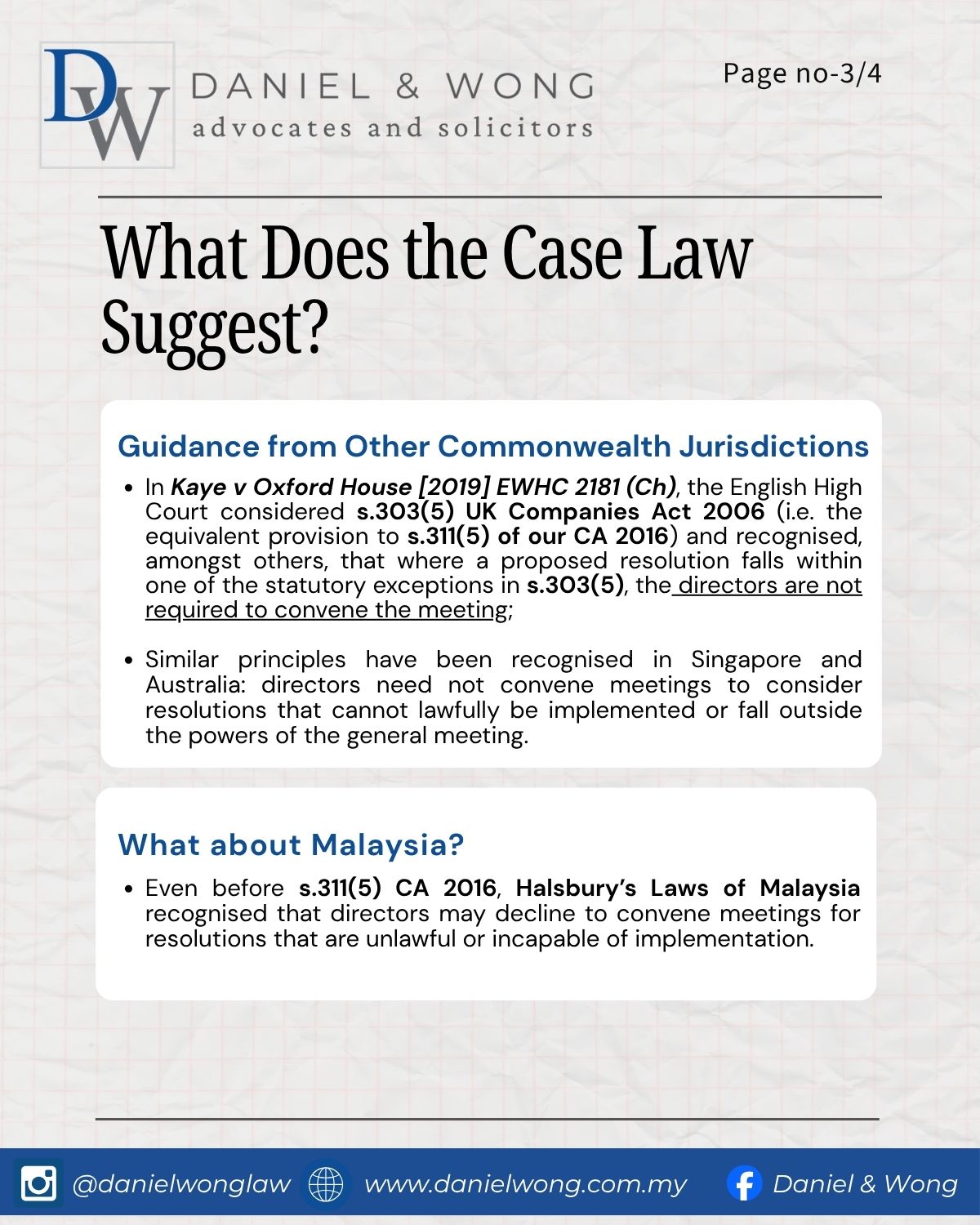
In Kaye v Oxford House [2019] EWHC 2181 (Ch), the English High Court considered the purpose and operation of S.303(5) of the UK Companies Act 2006 and observed, amongst others, that:-
- upon receiving a members’ requisition, the directors are entitled to consider the proposed business and the text of the proposed resolutions (if applicable) during the statutory period prescribed for convening the meeting;
- the purpose of that statutory period is to enable the directors to determine whether the proposed resolutions may properly be moved at the meeting;
- where a proposed resolution falls within one of the statutory exceptions in S.303(5), the directors are not required to convene the meeting;
- S.303(5) serves as a safeguard against abuse of the requisition process by the “lunatic fringe” (i.e. “those individuals whether alone or in concert with others, who wish to abuse the requisition process as a means of causing trouble, or making themselves a nuisance or trying to obtain the oxygen of publicity for causes that are only indirectly associated with the business and affairs of the company”);
- where the requisitioning member disputes the directors’ decision, the issue ultimately falls to be determined by the Court.
In fact, this was not a new principle. Even prior to S.303(5) of the UK Companies Act 2006, the English Courts had recognised that directors need not convene meetings solely for the purpose of considering resolutions that were incapable of producing any legal effect[4].
B. Other Commonwealth Jurisdictions
Similarly, the underlying principle stated above has also been recognised in other Commonwealth jurisdictions.
Singapore Australia In Singapore, the High Court held that the directors are entitled to decline to convene a meeting where the object of a requisition is to pass a resolution[5]: –
- which cannot legally be carried into effect; or
- which is ultra vires the powers of the general meeting.
Likewise, the Australian Courts have consistently recognised that directors are not obliged to convene meetings for purposes which cannot lawfully be achieved by members in a general meeting. [See:-
- National Roads & Motorists’ Association v Parker [1986] 11 ACLR 1, Australian Supreme Court.
- Windsor v National Mutual Life Association of Australasia Ltd [1992] 7 ACSR 210.]
C. Position in Malaysia Prior to S.311(5) CA 2016
Back in Malaysia, even prior to the enactment of S.311(5) CA 2016, the learned authors of Halsbury’s Laws of Malaysia observed that: –
“If the object of the meeting is to do that which cannot legally be carried into effect or to pass a resolution which is ultra vires the meeting, then the directors ought not to be required to convene the meeting. If such a meeting is in fact held and a resolution is passed, the directors are not bound to comply with it. The resolution is void and of no effect. There is nothing in the Companies Act 1965 to suggest that the directors must act on requisition for a meeting having as an object that which is not within the powers of the meeting. The directors are well entitled, on such a requisition, to decline to call a meeting…”
Viewed in this context, S.311(5) of the CA 2016 appears to reflect a principle long recognised across Commonwealth jurisdictions, namely that the statutory right to requisition a meeting does not ordinarily require directors to convene meetings for the purpose of considering resolutions which are unlawful, beyond the powers of the general meeting, or otherwise incapable of being validly implemented.
It is also noteworthy that, unlike S.303(5) of the UK Companies Act 2006, our S.311(5) CA 2016 contains an additional limb [i.e. limb (d) – a resolution, if passed, would not be in the best interest of the company].
The additional limb suggests a wider basis upon which directors may determine whether a proposed resolution may properly be moved. However, in the absence of judicial consideration of S.311(5)(d) CA 2016 by the Malaysian Courts, the precise scope and operation of this provision remain open to discussion.
Key Takeaways
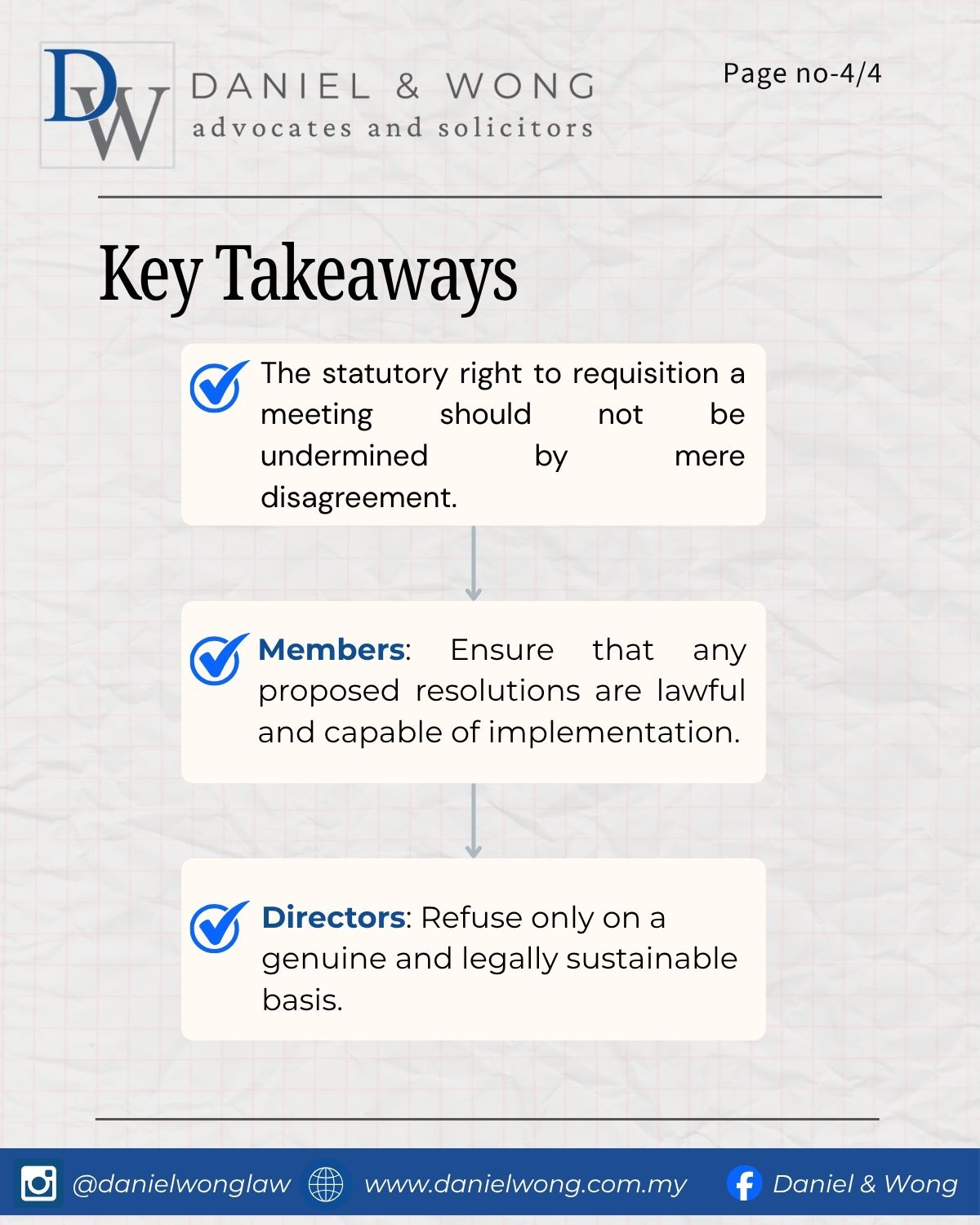
The statutory right to requisition a meeting is an important shareholder right and should not be undermined merely because the directors disagree with the proposed resolutions.
Members should ensure any proposed business and resolutions contained in a requisition notice are legally competent and capable of being validly implemented.
Directors should only refuse to convene a requisitioned meeting where there is a genuine and legally sustainable basis for concluding that the proposed business or resolution falls within one of the limited exceptions recognised by the law.
[1] Golden Plus Holdings Bhd v Teo Kim Hui [2021] 7 MLJ 852. para [28]
[2] EKA Noodle Bhd v Norhayati bt Tukiman [2021] MLJU 1586, para [28] – [31]
[3] S.313(6) & (7) CA 2016
[4] Rose v McGivern and others [1998] 2 BCLC 593, p.604 – 605
[5] Credit Development Pte Ltd v IMO Pte Ltd [1993] 1 SLR (R) 68. para [14] – [19]

This article was prepared by Nicholas Yap (Senior Associate).
Nicholas Yap Chun Yew is a Senior Associate at Daniel & Wong, specialising in corporate and commercial litigation within the firm’s dispute resolution practice group.
Our Dispute Resolution practice specialises in high-stakes civil, commercial and corporate disputes, including shareholders’ disputes, breach of contract, and debt recovery. We have experience representing clients at all levels of the Malaysian Courts, providing strategic and commercially sensible solutions to complex legal challenges.
If you require advice or representation in a legal dispute, please reach out to our team via our contact page.
Disclaimer: The content of this article is intended for general informational purposes only and does not constitute formal legal advice.
If you found this article useful, please feel free to download the PDF document in the link here.
- Announcement - DRJuly 1, 2026
Daniel & Wong is pleased to share that we are collaborating with the ATC Moot Society for their upcoming Written Submission Workshop and Annual Written Submission Competition.
Strong written advocacy is fundamental to effective litigation. Through this two-part initiative, we aim to help students bridge the gap between academic theory and courtroom practice.
🗓️ Key Details:
- The Workshop (15.7.2026, 6.30 PM): A practical session led by our Dispute Resolution Associate, Thevan Aruljothi, at the ATC KL Campus.
- The Competition (Contract Law): Put your drafting skills to the test. The moot problem releases on 15.7.2026, with a submission deadline of 15.8.2026.
We look forward to engaging with the next generation of legal talent.
For further details, please refer to the attached posters.
Posters courtesy of ATC Moot Society.
- June 26, 2026
Overview
In the recent decision of Tan Sing How & Ors v Ng Ze Xuan (Civil Appeal No.: B-02(W)-659-04/2024), the Court of Appeal (“CA”) addressed, amongst others, the Court’s jurisdiction to order the publication of an apology, as well as the assessment of damages arising from successive defamatory publications.
While the CA affirmed the finding of liability and rejected the pleaded defences, the CA set aside the High Court’s order for an apology to be issued[1] and further reduced the aggregate award of RM 600,000.00 to a global sum of RM 100,000.00.
Significantly, two written judgments were issued concerning the availability of apologies as a remedy in defamation proceedings. The Main Judgment was delivered by YA Dato’ Ong Chee Kwan JCA (with whom YA Datuk Mohamed Zaini bin Mazlan JCA concurred), while YA Tuan Muniandy A/L Kannyappan JCA delivered a Supporting Judgment expressing additional observations on the issue. They may be briefly summarised as follows.
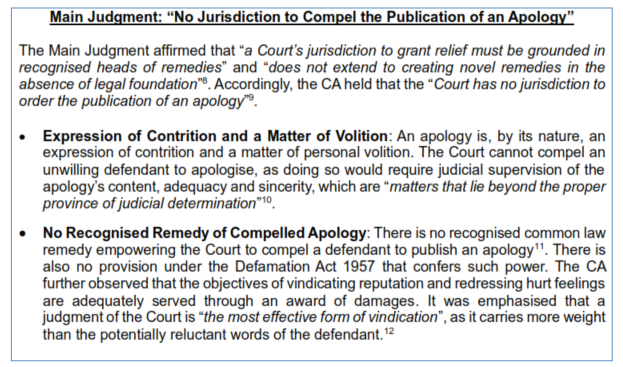
- The Main Judgment: Held that “a Court’s jurisdiction to grant relief must be grounded in recognised heads of remedies, whether statutory, common law or equitable” and that the Court has no jurisdiction to order the publication of an apology[2].
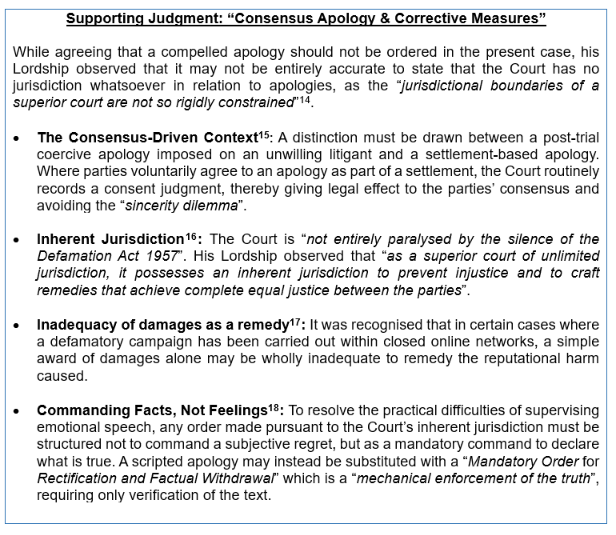
- The Supporting Judgment: Distinguished between compelled expressions of remorse and correction statements. His Lordship observed that, in an appropriate case, a “Mandatory Order for Rectification and Factual Withdrawal” may, in principle, provide an alternative to a scripted apology by requiring the defendant to declare objective facts rather than express subjective remorse. Such an order was described as a “mechanical enforcement of the truth”, requiring only verification of the text[3].
Brief Background Facts
- The Parties:
- TSH and LPK are the founders and directors of Kalysta Sdn Bhd (“Appellants”), an online weight-loss supplement marketing company in Malaysia. NZX (“Respondent”) served as a high-ranking General Agent of Kalysta Sdn Bhd, managing a subgroup of over 400 sales representatives.
- The Dispute:
- Following internal company investigations into the Respondent’s alleged involvement with a separate commercial entity and an unauthorised marketing incident, the Appellants terminated the Respondent’s agency relationship on 26.6.2021. The Appellants also pursued a counterclaim for the return of performance bonuses and account access.
- The Impugned Publications:
- Over a compressed period of eight days between 16.7.2021 and 24.7.2021, the Appellants published a series of seven statements (“Impugned Statements”). These publications were disseminated within closed online networks, such as WeChat and Instagram group chats, where the Respondent was described in terms including “compulsive liar” and “manipulative leader”.[4]
High Court (“HC”) Decision
- The HC found that each of the Impugned Statements bore defamatory meanings and adopted a segmented approach in assessing damages, treating each Impugned Statement as giving rise to separate liability by reference to their respective publications made on different occasions[5].
- The HC awarded separate blocks of general and aggravated damages against each Appellant for the respective Impugned Statements, culminating in a cumulative liability of RM600,000.00.
- Pertinently, having found the Impugned Statements to be defamatory, the HC further ordered the Appellants to tender an apology to the Respondent based on the language and contents proposed by her.[6]
- Dissatisfied, the Appellants appealed against the HC’s decision to the CA.
Decisions & Key Findings
The CA affirmed the HC’s decision that the Impugned Statements were defamatory of the Respondent and rejected the pleaded defences. However, the CA set aside the HC’s order for an apology to be issued[7] and reduced the quantum of damages awarded.
(1) Court’s Jurisdiction to Compel an Apology as a Remedy
- The Main Judgment essentially held that the Court has no jurisdiction to order the publication of an apology under the law.
- On the other hand, the Supporting Judgment, while concurring that no apology should be ordered on the facts, contemplated the possibility that the Court may, in appropriate cases, exercises its inherent jurisdiction to order corrective non-monetary remedies[13].
(2) Assessment of Damages: Cases of Successive Publications
Separately, the CA also reduced the quantum of damages, adopting a global assessment and holding that the Impugned Statements formed part of a continuous course of conduct and should not be assessed in a fragmented or duplicative manner.
- Continuous Course of Defamation[19]: Although each defamatory publication constitutes a separate cause of action, the CA held that the seven Impugned Statements should not be treated in a fragmented manner. Published within a compressed timeframe and arising from the same underlying allegations, they formed part of a coherent narrative. A global assessment of damages, therefore, better reflected the cumulative nature of the reputational harm and avoided artificial fragmentation, duplicative compensation and mechanical multiplication of awards.
- Absence of Proven Substantial Harm[20]: While defamation is actionable per se, the CA found no clear evidence of financial loss or significant reputational impact. Having regard to comparable authorities, the CA accordingly considered a global award of RM 100,000.00 to be fair, reasonable and proportionate in the circumstances.
Key Takeaways
Court Cannot Compel an Apology:
Even where a plaintiff succeeds at trial, the Court cannot compel an unwilling defendant to publish an apology. An apology remains a voluntary expression of remorse rather than a coercive post-trial remedy.
Corrective Relief May be Worth Considering:
In cases involving online publications or closed online networks, parties may consider seeking corrective statements, withdrawals or retractions, particularly in light of the observations made in the Supporting Judgment.
Global Assessment of Damages in Related Publications:
Where multiple defamatory publications form part of a single continuous course of conduct arising from the same underlying allegations, the Court may adopt a global assessment of damages to avoid fragmented or duplicative awards.
Conclusion
The decision is significant for clarifying the limits of remedial relief in Malaysian defamation law.
The Main Judgment reaffirmed that a compelled apology is not a permissible post-trial remedy and that the Court’s jurisdiction must be grounded in recognised heads of relief.
The Supporting Judgment, meanwhile, highlights the possibility that corrective non-monetary remedies may be available in appropriate cases, particularly where reputational harm arises within closed online networks.
[1] Para 94 of the Main Judgment (Civil Appeal No.: B-02(W)-659-04/2024, Encl 71, “Main Judgment”)
[2] Para 67 & 68 of the Main Judgment
[3] Para 8 & 9 (Civil Appeal No.: B-02(W)-659-04/2024, Encl 72, “Supporting Judgment”)
[4] Para 7 – 26 of the Main Judgment
[5] Para 27 & 70 of the Main Judgment
[6] Para 54 of the Main Judgment
[7] Para 94 of the Main Judgment
[8] Para 67 of the Main Judgment
[9] Para 68 of the Main Judgment
[10] Para 56 of the Main Judgment
[11] Para 55 of the Main Judgment
[12] Para 64 & 66 of the Main Judgment
[13] Para 6 of the Supporting Judgment
[14] Para 3 of the Supporting Judgment
[15] Para 4 & 5 of the Supporting Judgment
[16] Para 6 of the Supporting Judgment
[17] Para 7 of the Supporting Judgment
[18] Para 8 & 9 of the Supporting Judgment
[19] Para 72 – 81 of the Main Judgment
[20] Para 83 – 91 of the Main Judgment

This article is prepared by Nicholas Yap (Senior Associate) and Amanda Yap (Associate).
Nicholas Yap Chun Yew is a Senior Associate at Daniel & Wong within the Dispute Resolution department. He specialises in civil, corporate and commercial litigation, with a focus on corporate and shareholder disputes, fraud and asset recovery, defamation and insolvency matters.
Amanda Given is an Associate at Daniel & Wong, where she is a part of the firm’s Dispute Resolution department, specialising in civil, corporate and commercial litigation.
Our Dispute Resolution practice specialises in high-stakes civil, commercial and corporate disputes, including shareholders’ disputes, breach of contract, and debt recovery. We have experience representing clients at all levels of the Malaysian Courts, providing strategic and commercially sensible solutions to complex legal challenges.
If you require advice or representation in a legal dispute, please reach out to our team via our contact page.
Disclaimer: The content of this article is intended for general informational purposes only and does not constitute formal legal advice. Please refer to the Grounds of Judgment in the Federal Court Civil Appeal No. 02(f)-9-03/2025(W).
If you found this article useful, please feel free to download the PDF document in the link here.
- Announcement - DRJune 12, 2026
Daniel & Wong is pleased to announce that our Senior Associate, Nicholas Yap, will be speaking at Advance Tertiary College’s upcoming legal talk session titled “Optimising Legal Practice with Technology: What Future Lawyers Need to Know“, scheduled for 25 June 2026, alongside Ms Santhi Latha.
The session will examine the impact of legal technology, artificial intelligence, and innovation on the practice of law, as well as the skills future lawyers should develop to thrive in a rapidly evolving legal landscape.
We thank Advance Tertiary College (ATC) for the invitation and look forward to contributing to this timely discussion on the future of legal practice.
For further details, please refer to the attached poster.
Poster courtesy of ATC.
- May 28, 2026
Overview
In the recent decision of ISM Sendirian Berhad v Queensway Nominees (Asing) Sdn Bhd & Ors, the Federal Court (“FC”) revisited the scope of minority oppression under section 181 of the Companies Act 1965 (“CA 1965”) [now section 346 of the Companies Act 2016].
The appeal centred on a recurring issue in shareholder disputes: whether a breach of a shareholders’ agreement can sustain a statutory oppression claim.
In clarifying its earlier decision in Jet-Tech Materials Sdn Bhd & Anor v Yushiro Chemical Industry Co Ltd & Ors [2013] 2 CLJ 277 (“Jet-Tech”), the FC reaffirmed that to sustain a claim under s.181 of the CA 1965, “the conduct complained of must relate to or be a matter in the company’s affairs”[1].
The decision reinforces the distinction between private contractual disputes between shareholders and statutory oppression claims grounded in corporate conduct.
Background
The dispute arose out of a joint venture (“JV”) for an integrated commercial development in Kuala Lumpur known as the “Imbi Project”.
- The Appellant, ISM Sendirian Berhad (“ISM”), owned by Dato’ Ray Cheah (“Dato Ray”) and his wife, held a 30% minority equity stake in five JV companies incorporated to acquire 11 parcels of land for the project.[2]The remaining 70% majority stake was held by the 6th Respondent, MPHB Capital Berhad (“MPHB”).
- The five JV companies (1st – 5th Respondents) were structured as single-purpose vehicles, intended solely for land acquisition for the project rather than ongoing commercial operations[3].
- Although a draft shareholders’ agreement was prepared, it was never executed. The parties proceeded on the mutual understanding that they were bound by an oral agreement.[4]
The dispute concerned funding obligations[5]:
- ISM contended that the funding was split into cash and loan components, limiting its obligation to 30% of the cash portion (approximately 9% of the total acquisition costs).
- MPHB countered that funding obligations must strictly follow a 30:70 equity-based contribution across the board.
Following this disagreement, ISM commenced proceedings under s.181 of the CA 1965[6] alleging, amongst others, minority oppression, including funding demands, dilution via rights issues, and the imposition of interest on shareholder advances.
MPHB counterclaimed, amongst others, seeking a judicial declaration that the JV arrangement had been lawfully terminated by reason of ISM’s alleged breach of funding obligations, alongside claims for interest and opportunity costs[7].
High Court (“HC”) & Court of Appeal (“CA”) Decision
The HC found in ISM’s favour on three out of the five grounds. The remaining two grounds were dismissed, and no appeal was pursued against those findings. [8]
The CA reversed this decision, holding that the core dispute concerned the oral shareholders’ agreement between ISM and MPHB. As it did not relate to the “affairs of the company”, it was a private matter falling outside the statutory scope of s.181 of the CA 1965. [9]
Leave Questions at FC
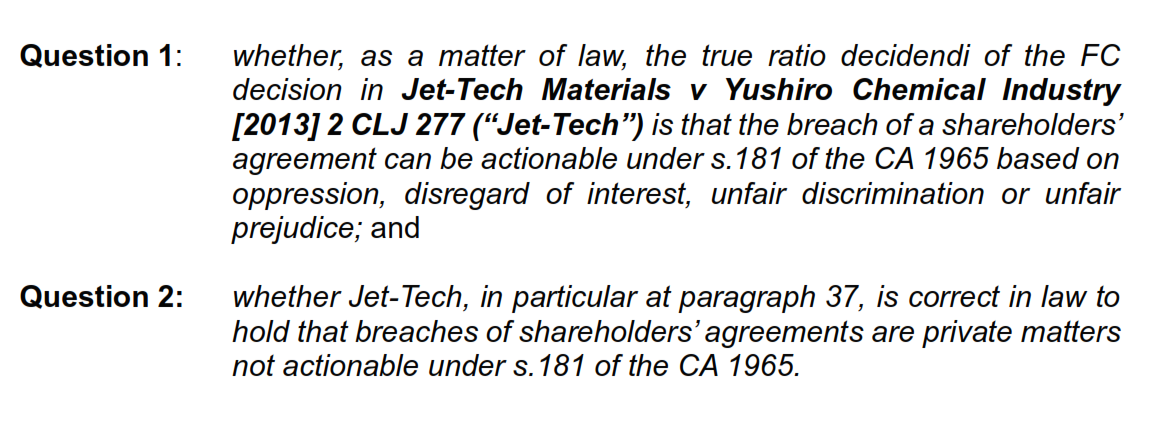
The FC essentially granted leave on two questions [10]: –
Decisions & Key Findings
The FC dismissed both of the Appellant’s appeals and found no appealable error warranting appellate intervention.
(1) The Scope of Jet-Tech & “Affairs of the Company”
The FC undertook a close examination of Jet-Tech, in particular, on paragraph 37.
- The FC reaffirmed that a claim under s.181 of the CA 1965 requires that the conduct complained of must relate to the “affairs of the company”. In doing so, it clarified that Jet-Tech does not establish a blanket prohibition against oppression claims founded on breaches of shareholders’ agreements, and that paragraph 37 must be read in its factual context.
“[70] … there is no express pronouncement or indication in paragraph 37 or any part of the grounds of judgment that any breach of the shareholders’ agreement is not actionable under section 181 of the CA 1965”.
- The critical inquiry is whether the conduct complained of, in substance, relates to the affairs of the company.
- The phrase “affairs of the company” is broad and encompasses, amongst others, capital structure, dividend policy, voting rights, and generally “all matters which may come before the board for consideration”.[11] However, this broad formulation does not extend to purely inter se disputes between shareholders.
- The FC drew a clear distinction: “the company’s affairs cannot be equated with those of its shareholders”. Private arrangements remain a matter for private law remedies, if any[12].
- Applying these principles, the FC held that the principle of law in paragraph 37 of Jet-Tech is correct and its application is inherently fact-sensitive. Accordingly, Question 2 was answered in the affirmative. [13]
- On the facts, the five JV companies were passive special purpose vehicles with limited operational activity, incorporated solely for land acquisition, with no substantive business operations. The FC agreed with the CA that, in light of the nature of the JV companies as passive holding vehicles, the dispute did not concern the “affairs of the company”.[14]
- In these circumstances, the FC held that the requirement of conduct relating to the “affairs of the company” was not satisfied and the oppression claim under section 181 could not be sustained.[15]
(2) Establishing a Quasi-Partnership
The FC rejected the Appellant’s alternative argument that the JV amounted to a “quasi-partnership” capable of invoking equitable standards of fairness.
- A quasi-partnership requires a foundation of personal relationship, mutual trust, and confidence, typically arising from prior or long-standing dealings.[16]
- On the facts, ISM and MPHB had no prior dealings or business transactions, and their dealings in relation to the JV were limited and commercial in nature[17].
- The JV was negotiated and structured as an arm’s length transaction between business entities, where MPHB treated it purely as a standard commercial investment proposal.
- Accordingly, the factual threshold for a quasi-partnership was not met, and equitable considerations were not engaged.[18]
Key Takeaways
Scope of S.181 of the CA 1965 (now s.346 CA 2016) Clarified
Minority oppression is only engaged where the impugned conduct relates, in substance, to the affairs of the company, not merely inter se shareholder disputes.
Contractual breaches do not equate to oppression
A breach of a shareholders’ agreement does not, without more, constitute oppression. The critical inquiry is whether the conduct, in substance, affects “affairs of the company”.
Substance over form governs the analysis
The Courts will examine the substance of the complaint rather than how it is pleaded or labelled.
SPV structure limits oppression claims
Where JV companies function as passive special-purpose vehicles with no substantive business operations, disputes are more likely to be characterised as private commercial disagreements.
Quasi-Partnership remains a high-threshold exception
Equitable intervention requires clear evidence of relational trust and dependency. Arm’s length commercial dealings, even in a JV context, will generally not suffice.
Conclusion
The FC’s decision confirms that paragraph 37 in Jet-Tech should not be read as establishing a categorical exclusion of minority oppression claims simply because the dispute concerns a shareholders’ agreement.
The critical inquiry remains whether, in substance, the impugned conduct relates to the “affairs of the company” under s.181 of the CA 1965, in which case shareholders’ agreement matters could still be the subject matter of a claim under s.181.
Ultimately, the ruling turns on characterisation: whether the alleged wrong implicates the “affairs of the company” or remains a private dispute between shareholders.
[1] Para [70] of ISM Sendirian Berhad v Queensway Nominees (Asing) Sdn Bhd & Ors
[2] Paras [23] – [25]
[3] Para [79]
[4] Para [31], [36], [40]
[5] Paras [32] – [33]
[6] Para [34 (a) – (e)]
[7] Para [35]
[8] Paras [36] – [39]
[9] Paras [40] – [4]
[10] Para [3 (i) & (ii)]
[11] Paras [66] – [67]
[12] Paras [68]
[13] Para [78]
[14] Para [79]
[15] Para [81]
[16] Para [85], [86], [90]
[17] Para [88] – [91]
[18] Para [91]
This article is prepared by Amanda Yap (Associate).
Amanda Given is an Associate at Daniel & Wong, where she is a part of the firm’s Dispute Resolution department, specialising in civil, corporate and commercial litigation.
Our Dispute Resolution practice specialises in high-stakes civil, commercial and corporate disputes, including shareholders’ disputes, breach of contract, and debt recovery. We have experience representing clients at all levels of the Malaysian Courts, providing strategic and commercially sensible solutions to complex legal challenges.
If you require advice or representation in a legal dispute, please reach out to our team via our contact page.
Disclaimer: The content of this article is intended for general informational purposes only and does not constitute formal legal advice. Please refer to the Grounds of Judgment in the Federal Court Civil Appeal No. 02(f)-9-03/2025(W).
If you found this article useful, please feel free to download the PDF document in the link here.
